



Category: News
Legislative and Enforcement Practice Digest: September 2026
Dear Colleagues,
Updating the information previously provided, we present a fresh overview of recent legislative developments and enforcement practice covering September 2026, as well as changes expected in the coming months.
1. Payments
1.1. New restrictions on taking cash rubles abroad
On 29 September 2026, the President of the Russian Federation signed Decree No. 706, amending Decree No. 193 of 25 March 2026 on the special procedure for taking Russian cash currency abroad. The decree entered into force on the date of signature (see also media reports 1, 2).
Key changes:
- For individuals, the limit on taking cash rubles to EAEU member states has been reduced from the equivalent of USD 100,000 to RUB 1 million; any excess is subject to seizure. Larger amounts may still be taken out only through international airports designated by the Russian Government, with bank documents confirming withdrawal of the funds from an account;
- The restrictions have been extended to Azerbaijan, Tajikistan and Uzbekistan;
- For legal entities and individual entrepreneurs, the ban in force since 1 April 2026 on taking cash rubles to these countries remains in place regardless of the amount; a violation entails seizure of the entire amount. Exceptions apply to international transport where both the point of departure and destination are outside Russia, subject to supporting documents, and to transfers based on notification by the Russian Ministry of Foreign Affairs to support diplomatic missions and consular posts.
The Russian Government, in agreement with the Bank of Russia, has been instructed to approve a procedure for recording cash rubles taken abroad within three months.
The following previously introduced restrictions also remain in force:
- Since 2 March 2022, taking foreign cash currency exceeding the equivalent of USD 10,000 out of Russia has been prohibited;
- The Bank of Russia has extended restrictions on foreign cash withdrawals until 9 March 2027: individuals may withdraw no more than USD 10,000, or the equivalent in euros, from foreign-currency accounts opened before 9 March 2022; residents may receive cash US dollars, euros, pounds sterling and yen only for business travel expenses within the prescribed limits; non-residents may not receive cash in these currencies.
1.2. Non-resident transfers: restrictions retained
The Bank of Russia has retained for six months from 1 October 2026 the ban on transfers abroad from accounts held with Russian brokers and trust managers by non-resident individuals and legal entities from unfriendly states. Funds of foreign investors recorded in type “In” accounts remain exempt.
As a reminder, the Bank of Russia’s general restrictions on cross-border transfers by non-residents from unfriendly countries are currently in place through 7 December 2026 inclusive.
Individuals resident in unfriendly countries who are officially employed in Russia may transfer funds abroad up to the amount of their salary. The ban on transferring funds abroad remains in place for legal entities from unfriendly states; it does not apply to foreign companies controlled by Russian persons.
No decision has yet been taken on the arrangements to apply after 7 December.
1.3. New channels: cryptocurrency settlements in foreign trade
As previously reported, Federal Law No. 282-FZ “On Digital Currencies and Digital Rights” entered into force on 1 September 2026, allowing digital currency to be used for settlements under foreign trade contracts (see our previous overview and our 2024 article on the legalization of cryptocurrencies).
On the same day, according to media reports, Sberbank launched a cross-border cryptocurrency settlement service for corporate clients engaged in foreign trade. Public sources indicate an average transaction cost of 0.3%, no minimum payment amount, transfers between crypto wallets completed within minutes, and automatic generation of documents for currency control purposes (see report).
Legislation on the taxation of cryptocurrency transactions is still being developed. Before using the new channel, we recommend agreeing with your bank on the supporting documents required and reviewing the accounting and tax treatment of such settlements.
1.4. Bank of Russia plans for cross-border settlements
On 11 September 2026, the Bank of Russia published the draft Guidelines for the Development of the Financial Market for 2027–2029.
For foreign trade settlements, the regulator plans to develop alternative settlement mechanisms and payment channels, reduce business costs and gradually lift restrictions on capital movements as the economy adapts.
In addition, according to media reports, the Bank of Russia plans to increase the limit on transfers between legal entities through the Faster Payments System. The timing and specific parameters have not yet been determined; we will monitor developments.
1.5. Digital ruble: the first stage of mass implementation has begun
From 1 September 2026, systemically important banks and banks significant in the payment services market must enable clients to transact in digital rubles. Merchants with revenue exceeding RUB 120 million in the previous year that are serviced by such banks must accept digital ruble payments (see Bank of Russia information). Further stages are scheduled for 1 September 2027 and 1 September 2028.
2. Banking news
2.1. Tax registration through a bank for foreign organizations
From 1 September 2026, under Federal Law No. 416-FZ of 17 November 2025, a foreign organization opening an account with a Russian bank is registered with the tax authority on the basis of the bank’s application. Within five days of receiving that application, the tax authority registers the organization and sends the bank an extract from the Unified State Register of Taxpayers. The foreign company no longer needs to apply to the tax authority itself.
For more on opening and servicing accounts for foreign companies, their Russian subsidiaries and representative offices, see our overview.
See also our overview of the legal forms through which foreign businesses can operate in Russia.
2.2. More banks subject to sanctions
On 23 July 2026, the Council of the EU adopted the 21st sanctions package. In the financial sector:
- The transaction ban was extended to a further 33 Russian credit and financial institutions;
- A bank in Kyrgyzstan connected to the Financial Messaging System (SPFS), as well as three other banks in third countries facilitating sanctions circumvention, became subject to the ban;
- Transactions were prohibited with 14 cryptocurrency platforms registered in Georgia, Panama, the UAE, the Marshall Islands, Kyrgyzstan and Belarus;
- Courts and competent authorities in EU member states were granted the right to refuse recognition and enforcement of judgments arising from claims brought before Russian courts.
On 6 August 2026, the United Kingdom added six Russian banks to its sanctions list: Ozon Bank, Roseximbank, Center-invest Bank, Realist Bank, Stavr Bank and Teleport Bank.
On 18 September 2026, H.R. 5334, the Lindsey O. Graham Sanctioning Russia and Iran Act of 2026, was signed into law in the United States, expanding the statutory basis for sanctions, tariff measures and prohibitions concerning Russia. The practical consequences will depend on the US administration’s implementation decisions. We will monitor developments.
Before making cross-border payments, we recommend checking the current status not only of the payer’s and recipient’s banks but also of correspondent banks.
3. Supply chains
3.1. SPOT: security payments on supplies from Belarus from 1 November
As previously reported (see our previous overview), the System for Confirmation of Expected Goods (SPOT) has operated since 1 June 2026, and security payments have been mandatory for supplies from Armenia, Kazakhstan and Kyrgyzstan since 1 July.
The exemption from security payments for supplies from Belarus entering via the Russia–Belarus border applies through 31 October 2026 inclusive; no information on an extension was available when this overview was prepared.
Accordingly, from 1 November 2026, obtaining a QR code for goods imported from Belarus by road will require a security payment equal to the import VAT and excise duties.
According to information from the Ministry of Finance and the Federal Customs Service, additional budget receipts generated by the system had reached RUB 33.8 billion by 10 September 2026, against an annual target of RUB 50 billion.
The business community’s proposal to replace the security payment with a bank guarantee is to be considered in the autumn. Businesses also propose reducing the revenue threshold for exempting compliant taxpayers from RUB 30 billion to RUB 5–10 billion.
Final decisions on adjustments to the system have not yet been taken.
3.2. Customs monitoring: pilot extended until 2029
Russian Government Resolution No. 1188 of 18 September 2026 extends the customs monitoring pilot until 31 March 2029, previously 31 March 2027. Eligibility has also been expanded: Russian declarants not classified as high-risk may join. Applications will be accepted until 30 September 2028. The resolution enters into force on 19 October 2026.
As a reminder, participants provide customs authorities with remote access to data in their accounting systems and, where risks are identified, have an opportunity to rectify violations themselves before customs control measures are applied.
3.3. Electronic transport documents: no penalties before March 2027
From 1 September 2026, under Federal Law No. 140-FZ, carriers, freight forwarders, consignors and consignees are required to issue transport documents electronically through the State Information System for Electronic Transport Documents (GIS EPD). The requirement covers road, rail and air consignment notes, transport orders and freight forwarding documents.
Paper documents remain available, in particular:
- For military and special cargo transport;
- For transactions with foreign counterparties;
- For transport for individuals’ personal needs;
- For border-area operations and in territories with special status.
According to information from the Ministry of Transport, an adaptation period applies until 1 March 2027: penalties for using paper documents instead of electronic ones will not be imposed. Please note that the ministry announced this adaptation period, but no regulatory act on the matter had been published when this overview was prepared.
3.4. New obligations for manufacturers and importers
A technology levy introduced by amendments to the Federal Law “On Industrial Policy in the Russian Federation” will apply from 1 December 2026. Manufacturers and importers of radio-electronic products will pay the levy.
The Ministry of Industry and Trade has prepared a draft order setting rates, including RUB 746 per laptop and RUB 373 per smartphone; rates are lower for products included in the relevant directory and higher for those not included (see also media coverage). The rates remain at the draft stage.
In addition, from 1 October 2026, manufacturers begin applying identification markings to household and sanitary-hygiene products, including paper towels, toilet paper, toothbrushes and diapers. Registration in the Chestny ZNAK system has been mandatory since 1 September 2026 (Russian Government Resolution No. 656 of 30 May 2026).
4. Other developments
4.1. Taxation
4.1.1. Under discussion: 35% tax on dividends paid into type “C” accounts?
On 24 September 2026, the Russian Government approved the budget package for 2027–2029; the bills are scheduled to be submitted to the State Duma by 1 October. The proposed tax measures are intended to take effect from 2027 (see media reports 1, 2). They include:
- An increase from 15% to 35% in the corporate income tax rate on dividends paid into type “C” accounts to non-residents from unfriendly states;
- Taxation of individuals’ passive income, including dividends, deposit interest, securities transactions and property sales, at progressive rates of 13–22%; income from deposits of up to RUB 1 million would not be taxed;
- VAT at 22% on cross-border e-commerce, with electronic platforms acting as tax agents, and a customs fee of RUB 100 per parcel valued at up to EUR 200;
- Corporate income tax at 15% on passive income of mutual investment funds;
- A tax on additional income arising from increases in world prices for companies extracting solid minerals, at 30%, or 20% for gold producers.
The higher dividend tax rate would affect foreign groups receiving dividends from Russian subsidiaries. As a reminder, the double taxation treaty between Russia and Germany will also be suspended from 1 January 2027 (see our overview and Telegram post).
We recommend taking the proposed changes into account when planning the timing of profit distributions. The parameters may change as the bills are considered; we will monitor developments.
4.1.2. Official: new rules on tax penalties
From 1 September 2026, amendments to Articles 112 and 114 of the Russian Tax Code introduced by Federal Law No. 425-FZ of 28 November 2025 apply: where mitigating circumstances exist, a penalty is reduced by a factor of at least two but no more than ten; previously, there was no upper limit on the reduction (the amendments were introduced by Article 1 of Federal Law No. 425-FZ; see the current version of Article 114 of the Tax Code).
As a reminder, Bill No. 1215257-8 on easing liability for late submission of returns, which we previously reported, has been enacted as Federal Law No. 201-FZ of 26 June 2026:
- The penalty under Article 119(1) of the Tax Code does not apply if a late tax return or calculation shows no tax payable;
- Individuals are not fined for failing to submit a 3-NDFL return upon the sale or gift of real estate;
- Taxpayers may submit evidence of mitigating circumstances together with the late return.
4.1.3. Consideration of tax audit materials by videoconference
From 1 September 2026, Federal Law No. 425-FZ (Article 1; see the current versions of Article 101 and Article 101.4 of the Tax Code) amended Article 101(2) and Article 101.4(7) of the Tax Code to permit participation by videoconference in the consideration of tax audit materials and reports on tax offenses identified outside an audit.
The procedure for such participation was approved by Federal Tax Service Order No. ED-1-2/567@ of 11 August 2026, published on 31 August 2026 and entering into force one month after publication:
- Participants connect from the tax office at the organization’s location or the individual’s place of residence, provided the tax authorities have the technical capability;
- A request to participate by videoconference must be sent to the tax authority considering the materials;
- The tax authority must notify the applicant of the possibility of videoconference participation at least three working days before the hearing;
- In the event of technical failures, consideration is postponed or conducted in person; videoconferencing is not used where the materials contain state secrets.
At the same time, Federal Tax Service Order No. ED-1-2/568@ of 11 August 2026 approved the format and procedure for submitting written objections and supporting documents electronically.
4.1.4. Tax monitoring: new rules for reorganizations
Amendments to the tax monitoring procedure introduced by the same Law No. 425-FZ took effect on 1 September 2026 (Article 1; see the current version of Article 105.26 and the subsequent articles of Section V.2 of the Tax Code):
- Legal successors of reorganized participants may continue tax monitoring without meeting the monetary thresholds if they update the previously submitted documents within one month; the monitoring period is not interrupted by the reorganization;
- The grounds for early termination of monitoring have been expanded, including non-compliance with requirements for information exchange, information systems and internal control systems, and repeated violations of information access procedures.
As a reminder, our previous overview covered the government-approved bill on mandatory tax monitoring for special economic zone residents (see also our Telegram post). The general tax monitoring procedure is described in our overview.
4.1.5. Accounting: amendments to PBU 18/02
Russian Ministry of Finance Order No. 121n of 20 August 2026 amended PBU 18/02 “Accounting for Corporate Income Tax.” The amendments concern accounting for deferred tax assets and liabilities when corporate income tax rates change, and the recognition of income tax relating to transactions included in the period’s comprehensive financial result.
The order entered into force on 29 September 2026. We recommend assessing its impact on the 2026 annual financial statements in advance.
4.2. Corporate law and transactions with unfriendly persons
4.2.1. Temporary management in the event of security violations
Presidential Decree No. 604 of 24 August 2026 “On Measures to Ensure the Security of Critical Infrastructure Facilities of the Russian Federation” empowers the Russian Government, acting on instructions from the President, to introduce temporary management of business entities’ property where critical infrastructure security requirements are violated. The facilities concerned include fuel and energy, industry, communications, transport and logistics, municipal infrastructure and life-support facilities.
Grounds may include, in particular:
- Failure to take security measures, or delays in taking them;
- Ineffective organization of measures to counter unmanned aerial vehicles;
- Delays in restoring a facility’s operation.
Rosimushchestvo is appointed temporary manager unless the Government designates another person. The temporary manager may not dispose of the property. Unlike Decree No. 302, the new mechanism is not limited to assets of persons from unfriendly states.
4.2.2. Bill on creditor protection during reorganization
The Russian Government has submitted Bill No. 1342008-8 to the State Duma to amend Article 60 of the Civil Code. It proposes that a court should reject a creditor’s demand for early performance due to the debtor’s reorganization if the debtor demonstrates that there is no material threat to performance of the obligation.
If adopted, the amendments could facilitate intragroup reorganizations. The bill is under consideration.
As a reminder, the Russian Ministry of Finance previously clarified when corporate procedures in companies involving persons from unfriendly states do not require Government Commission approval (see our overview).
4.3. Migration
As previously reported, a range of migration law changes takes effect in 2026–2027. The principal changes and our recommendations for employers are set out in our full overview and Telegram posts on digital registration, new personal income tax payments and requirements for highly qualified specialists.
4.3.1. Medical examinations: a uniform 30-day deadline
From 1 September 2026, Federal Law No. 162-FZ of 10 June 2026 (Article 1, amending Article 5 and Articles 6, 6.1, 13 and 13.3 of Federal Law No. 115-FZ “On the Legal Status of Foreign Citizens in the Russian Federation”) establishes a uniform deadline for foreign nationals to undergo medical examinations: 30 calendar days from entry into Russia.
It applies to foreign nationals arriving for more than 90 days or for employment, and when obtaining a work permit, work patent or temporary residence permit. Repeat examinations are conducted annually.
Federal Law No. 163-FZ of 10 June 2026 (Article 1, introducing Article 18.11.1 of the Code of Administrative Offenses) introduced administrative liability for violations of the examination procedure: a fine of RUB 25,000–50,000, with possible administrative expulsion.
4.4. Employment relations
The Russian Government approved the working calendar for 2027 by Resolution No. 1187 of 17 September 2026. Days off are moved from 2 January to 5 November, from 3 January to 31 December, and from 20 February to 22 February. There are 247 working days in 2027; standard working time for a 40-hour week is 1,972 hours.
As a reminder, amendments to the Labor Code took effect on 1 September 2026 under Federal Law No. 144-FZ of 25 May 2026:
- The annual overtime limit may be increased from 120 to 240 hours if a collective agreement or sectoral agreement so provides;
- Overtime exceeding 120 hours is paid at no less than double the regular rate;
- The employee threshold for small businesses permitted to enter into fixed-term employment contracts by mutual agreement has been raised from 35 to 70.
4.5. Personal data: new criteria for “adequate” countries
Federal Law No. 265-FZ of 26 July 2026 was published and entered into force on 3 August 2026, changing the procedure for recognizing foreign states as ensuring adequate protection of personal data subjects’ rights. Participation in Council of Europe Convention No. 108 alone is no longer sufficient: a country’s rules must comply with the Convention and ensure personal data confidentiality and security.
Roskomnadzor approves the list of such states; an updated list had not been approved when this overview was prepared.
A country’s status affects cross-border data transfer procedures, including the use of a parent company’s information systems, cloud services and CRM systems.
We will monitor developments.
4.6. Upcoming deadlines
For planning purposes, we summarize adopted and expected changes taking effect in the coming months:
- 1 October 2026: commencement of marking household and sanitary-hygiene products (section 3.4); the procedure for considering tax audit materials by videoconference takes effect (section 4.1.3);
- 19 October 2026: the resolution extending and expanding customs monitoring takes effect (section 3.2);
- 23 October 2026: Bank of Russia Board meeting on the key rate, currently 14%;
- 1 November 2026: SPOT security payments for supplies from Belarus (section 3.1);
- 1 December 2026: collection of the technology levy begins (section 3.4);
- 7 December 2026: expiry of the current Bank of Russia restrictions on non-resident cross-border transfers (section 1.2);
- 1 January 2027: abolition of separate corporate income tax returns for certain separate subdivisions; suspension of the double taxation treaty with Germany; fixed advance personal income tax payments for foreign workers; an increase in the minimum wage to RUB 28,935, subject to enactment; budget-package tax measures, subject to enactment;
- 1 March 2027: new salary requirements for highly qualified specialists, RUB 717,000 per month (see our overview); end of the adaptation period for electronic transport documents (section 3.3);
- 9 March 2027: expiry of the current restrictions on foreign cash withdrawals (section 1.1);
- 1 September 2027: second stage of digital ruble implementation (section 1.5).
Other news

06.10.2026
Federal Notarial Chamber Clarifies a Number of Issues Regarding the Adoption of Decisions by Participants of an LLC

28.09.2026
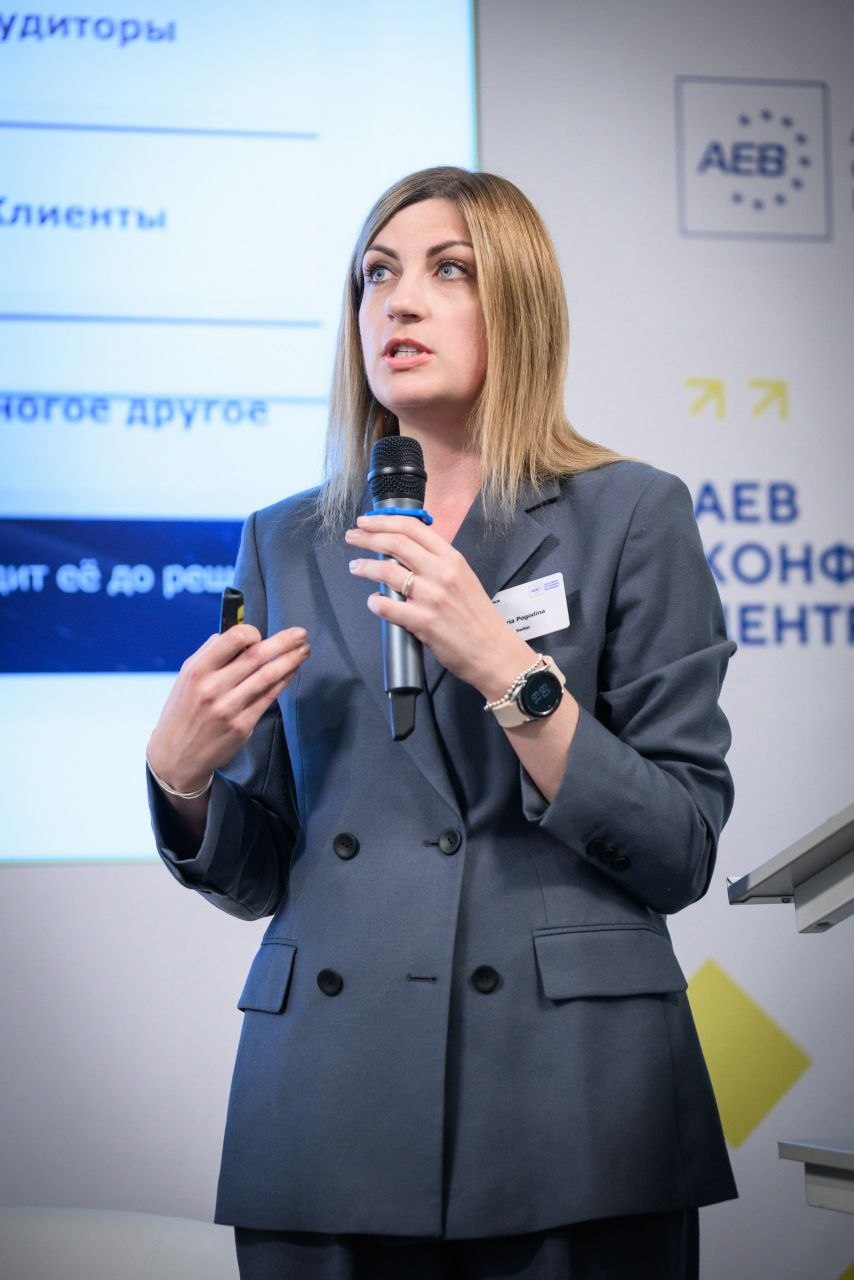
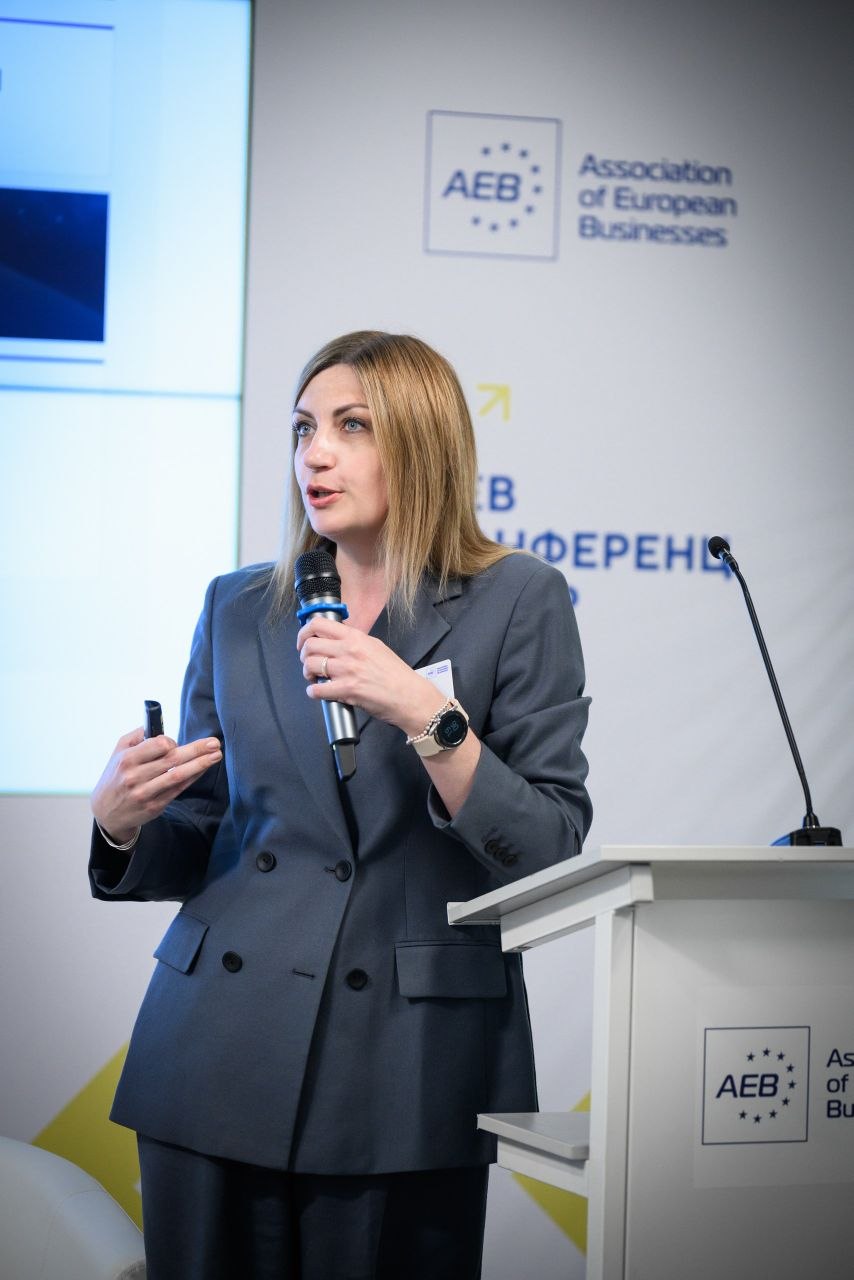
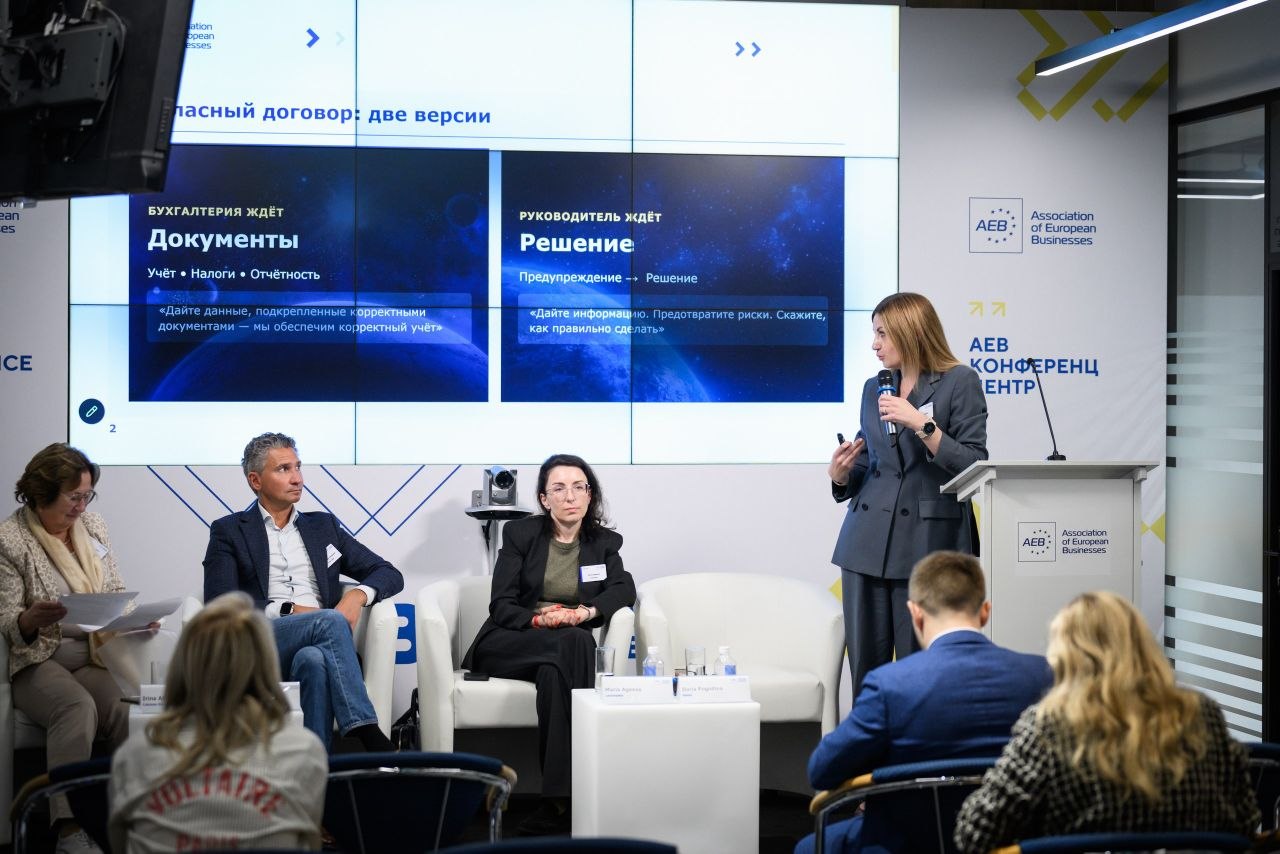
Daria Pogodina Spoke at the Association of European Businesses Conference
Daria Pogodina discussed the transformation of the finance function and management's expectations of accounting departments in 2026.

01.09.2026
Company Registration in Russia: Overview of Legal Forms for Foreign Business Presence
A consolidated overview of legal forms available for foreign business presence in Russia, including key registration, tax and reporting requirements relevant for 2026.
Federal Notarial Chamber Clarifies a Number of Issues Regarding the Adoption of Decisions by Participants of an LLC
Dear Colleagues!
The Federal Notarial Chamber (FNC), in its letter dated 06.07.2026 No. 6442/06-06, clarified issues that limited liability companies (LLCs) and the banks servicing them regularly encounter in practice. These clarifications directly affect all those involved in the adoption and implementation of decisions by LLC participants.
We remind you that Federal Law No. 287-FZ dated 08.08.2024 previously introduced a number of important amendments to the legislation on LLCs and JSCs (a detailed review of this topic can be found at the link).
Thus, since 01.09.2024, the decision on the election (appointment) of the sole executive body of an LLC (for example, the general director) must be certified by a notary. When registering such changes in the Unified State Register of Legal Entities (EGRUL), the notary becomes the applicant.
Previously, participants could adopt such a decision without a notary (if an alternative procedure was enshrined in the charter), and then the new director would sign the application for registration himself. Now, participants or their representatives must be personally present before a Russian notary to adopt the decision (with the issuance of a certificate), after which the notary signs and submits the application to the registering authority.
For foreign participants of Russian LLCs, in practice this means two options: either travelling to the Russian Federation and visiting a Russian notary, or issuing a power of attorney to Russian representatives (the power of attorney must be duly legalized and translated into Russian).
At the time the amendments entered into force, clarifications were expected as to whether notarial certification would be mandatory for decisions on the extension of the powers of general directors and on the commencement of liquidation.
In addition, a frequent question from practice was the need for notarial certification, for example, of the extension of the powers of an incumbent director: after all, in essence, the sole executive body does not change in such a case; only the term of its power changes.
The FNC has now provided the relevant clarifications.
Significance of the FNC Letter
The FNC letter is not a normative act and does not change the law. However, the FNC unites all notaries of the country and issues methodological recommendations that are binding. In practice, notaries will be guided by precisely these approaches when certifying decisions of LLC participants. Thus, the Chamber's clarifications are a rigid benchmark for law enforcement practice, including for registering authorities and banks, even if formally they do not change the law. Ignoring them when planning corporate procedures entails the risk of refusal of the notarial act, and consequently of registration of the changes.
1. Extension of the Powers of the Sole Executive Body (Director)
One of the key conclusions concerns the extension of directors' powers.
The FNC explicitly states: the extension of the powers of an incumbent general director is, in its legal sense, his election for a new term.
The decision on the election (appointment) of a director must be certified by a notary in accordance with the law. Consequently, the decision of the general meeting of participants on the extension of powers (or on re-election) must also be certified by a notary.
If the decision is not certified by a notary, it is void – that is, it does not produce legal consequences from the very outset. At the same time, there is no need to file an application for the extension of powers with the EGRUL, since the information about the person entitled to act without a power of attorney remains unchanged.
For companies, this means: a director whose powers have been formally "extended" but not certified by a notary may be recognized as acting without legal grounds, and all transactions signed by him after the expiry of the term may be challenged.
2. Transfer of Powers of the Sole Executive Body to a Managing Organization
The situation is different with the transfer of powers of the sole executive body to a managing organization.
The FNC confirms that mandatory notarial certification is not required for such decisions.
Such a decision may be confirmed by a notary, but may also be formalized in another way if this is provided for by the company's charter or by a unanimous decision of the participants (signing of the minutes by all participants present at the meeting is often used).
3. Decisions of LLC Participants Adopted Outside Russia
A separate block of clarifications concerns decisions of LLC participants adopted outside Russia.
The applicable legislation does not prohibit the certification of such decisions by a foreign notary.
However, a foreign notary can only confirm that a specific person signed the paper in his presence. He does not have access to the Russian register of legal entities (EGRUL), cannot verify the charter of the Russian company or compliance with the specific rules of Russian corporate law. He certifies a signature, whereas Russian law requires certification of the corporate fact of the adoption of a decision.
Furthermore, since 01.09.2024, a rule applies: a notary who has certified a decision on the election (appointment) of the sole executive body of an LLC must independently submit to the tax authority an application for amendments to the EGRUL in electronic form, signed with his enhanced qualified electronic signature. Foreign notaries do not have such capability.
Consequently, in practice, decisions of participants on the appointment of the sole executive body of an LLC cannot be certified by foreign notaries. Thus, for companies with foreign participation, the adoption of decisions regarding sole executive bodies is currently possible before Russian notaries under powers of attorney issued by the foreign participants, which has been actively implemented since the relevant amendments to the law entered into force.
4. Liquidation of an LLC
Another important aspect concerns the liquidation of an LLC. The FNC clarifies that the decision on the appointment of a liquidation commission or liquidator, as a general rule, must be confirmed in the same manner as other decisions of the general meeting of participants. This means that such a decision is subject to notarial certification unless the charter provides for another method of confirming its adoption (for example, signing of the minutes by all participants present at the meeting).
At the same time, the notification of the commencement of liquidation is submitted to the registering authority by the notary who certified the signature of the head of the liquidation commission (liquidator) on such notification.
Since 01.09.2024, it has been legislatively confirmed that the notary transmits to the Federal Tax Service the notification of the formation of the liquidation commission/appointment of the liquidator. Such notification is transmitted, as a rule, simultaneously with the notice that the legal entity is entering the liquidation process. The notification to the Federal Tax Service is transmitted by the notary who certified the liquidator's signature on it, no later than the end of the business day on which the notification was signed.
However, the FNC draws attention: from the moment of appointment of the liquidation commission, the powers to manage the affairs and dispose of the company's property pass to it, which means that the risks of abuse in this area are particularly high. For a company entering liquidation proceedings, this means that an error in formalizing the decision on the appointment of the liquidator may block the entire subsequent procedure.
5. FNC Proposals for Legislative Amendments
The FNC has also formulated proposals for legislative amendments. It proposes to establish mandatory notarial certification of decisions on the appointment of a liquidation commission (liquidator), irrespective of whether the charter provides for alternative methods of confirming the adoption of decisions by participants.
A similar proposal has been made in respect of decisions on the transfer of powers of the sole executive body to a managing organization. If these amendments are adopted, companies will no longer be able to rely on charter alternatives — the notary will become the only legitimate means of confirming such decisions.
Conclusions for Business
Thus, the letter of the Federal Notarial Chamber is a benchmark for law enforcement practice and at the same time a signal of the direction of possible legislative changes. For business, this means that practice is moving towards consolidating notarial certification of participants' decisions as the standard, especially in matters related to the management and liquidation of LLCs.
Ignoring these approaches already creates for a company the risks of decisions being recognized as void, of transactions of the director being challenged, of registration actions being blocked, as well as of bank accounts being blocked.
We constantly monitor legislative changes and will always be happy to answer your questions.
Other news

06.10.2026
Legislative and Enforcement Practice Digest: September 2026
September 2026 developments in payments, banking, supplies, taxation, corporate law and employment. Adopted and expected changes and upcoming business deadlines.
01.09.2026
Company Registration in Russia: Overview of Legal Forms for Foreign Business Presence
A consolidated overview of legal forms available for foreign business presence in Russia, including key registration, tax and reporting requirements relevant for 2026.
Daria Pogodina Spoke at the Association of European Businesses Conference
“Accounting is waiting for documents, while management is waiting for solutions”: last Tuesday, Daria Pogodina, General Director of SWILAR LLC and Managing Partner of the Swilar Group, spoke at the “People” session during a conference held by the Association of European Businesses. Her presentation was titled “The Evolution of Management’s Expectations for the Accounting Function: An Overview of 2026.”
The presentation addressed the transformation of the finance function and changes in management’s expectations of accounting departments in 2026. Daria shared company case studies and Swilar’s perspective on the current situation.

Other news
06.10.2026
Legislative and Enforcement Practice Digest: September 2026
September 2026 developments in payments, banking, supplies, taxation, corporate law and employment. Adopted and expected changes and upcoming business deadlines.
06.10.2026
Federal Notarial Chamber Clarifies a Number of Issues Regarding the Adoption of Decisions by Participants of an LLC
01.09.2026
Company Registration in Russia: Overview of Legal Forms for Foreign Business Presence
A consolidated overview of legal forms available for foreign business presence in Russia, including key registration, tax and reporting requirements relevant for 2026.
Company Registration in Russia: Overview of Legal Forms for Foreign Business Presence
Dear colleagues,
for those considering entering the Russian market and currently analyzing the most suitable presence structure and developing their strategy, we have prepared a comprehensive overview of the organizational and legal forms available for foreign business presence in Russia.
Choosing the right structure is a strategic decision that determines the permissible scope of activities, tax burden, extent of parent company liability, management framework, and access to banking services.
In this article, we have compiled a brief overview of the available legal forms of presence in the Russian Federation, as well as key registration, tax, and reporting requirements relevant for 2026.
Our overview is structured to guide you from a general description of the forms to specific procedures, taxes, and practical recommendations.
We hope that our material will be useful and assist you in making decisions that are relevant to your specific business.
Basic Forms of Foreign Business Presence in the Russian Federation: Brief Overview
Russian law identifies several most common forms of legal business presence in the Russian Federation that are available to founders from foreign countries.
Each option has its own characteristics, legal nature, and degree of liability that may extend to the foreign owner.
1. Limited Liability Company (LLC / rus. OOO)
This is an independent legal entity – a resident of the Russian Federation, established under Russian law.
A foreign company may act as a participant (founder) and hold 100% of the share without restrictions.
Until 2026, there was a restriction on the so-called “matryoshka” structure. This term is used in Russia to describe a chain of ownership where legal entities hold 100% participation in each other (Company A holds 100% of Company B, which holds 100% of Company C). In 2026, this restriction was officially lifted, and such ownership structures are now permissible in the Russian Federation.
The number of LLC participants may reach up to 50 individuals or legal entities.
Mixed ownership structures are permitted: for example, part of the shares may belong to individuals (Russian or foreign), and part to legal entities.
LLCs may conduct almost any type of activity (manufacturing, trade, services). Certain types require licenses (f.e. banking, insurance, medical, educational) or special permits.
Liability is limited: the LLC is liable for its obligations with its own assets; participants risk only to the extent of their contributions.
2. Joint-Stock Company (JSC / rus. AO)
This is an independent legal entity – a resident of the Russian Federation, established under Russian law.
Unlike an LLC, a JSC is a legal entity with share capital divided into shares. There are public (PJSC / rus. PAO) and non-public (NJSC / rus. NAO) joint-stock companies.
If at the time of establishment the JSC has more than one shareholder, the list of shareholders will be closed to public access, meaning it will not be visible in public sources.
In terms of day-to-day operations, the structure compared to an LLC is generally more suitable for large-scale projects and attracting external capital. This is due, among other reasons, to the fact that the JSC structure imposes enhanced requirements for disclosure, submission of additional reports, and corporate governance.
Since this form of presence is relatively rarely chosen by foreign founders for market entry, we will not discuss it in further detail.
3. Branch of a Foreign Company
A branch is a separate subdivision that is not an independent legal entity and operates on behalf of the parent company.
A branch may, with certain limitations (for example, when importing products), conduct commercial activities (enter into contracts, receive revenue).
However, since the branch is not an independent legal entity, the parent company bears full liability for the branch’s obligations.
4. Representative Office of a Foreign Company
Like a branch, a representative office is a separate subdivision, not an independent legal entity.
However, unlike a branch, the activities of a representative office are limited to representative, not commercial, functions. This implies representing interests, marketing, advertising, conducting negotiations, finding partners, etc. A representative office cannot receive revenue on its own behalf, conduct production, or provide paid services.
Since the representative office is not an independent legal entity, the parent company bears full liability for its obligations.
The head office may directly finance the activities of the representative office without any additional contractual arrangements.
Key Details and Requisites of a Legal Entity in the Russian Federation
After completing registration (or accreditation), the organization receives a set of mandatory identification details (in addition to bank details), which are used in all legal relationships – from contracts with counterparties to banking services and tax reporting.
1) Company Name
The procedure for naming a company in the Russian Federation requires mandatory indication of the legal form in the corporate name – for example, the full name “Общество с ограниченной ответственностью «Трейдинг Интернейшенл»” (Limited Liability Company “Trading International”), abbreviated as “ООО «Трейдинг Интернейшенл»” (LLC “Trading International”).
The name must contain not just a designation of the type of activity (e.g., LLC “Hairdressing Salon”) but also a unique part that distinguishes the organization from others.
Registration is permitted for the full and abbreviated name in Russian, as well as versions in a foreign language (these are also included in the constituent documents).
When choosing a name, several restrictions must be considered:
- It may not include names of states, government bodies, or public associations;
- Words that contradict public interests and morality;
- Use of the words “Russia,” “Russian Federation,” and derivatives thereof is only possible with special permission;
- Additionally, the name must not be identical or confusingly similar to the name of another organization engaged in similar activities – to minimize risks, it is advisable to check variants in the Unified State Register of Legal Entities (USRLE / rus. EGRUL) and the Rospatent trademark database.
The full and abbreviated company name in Russian and (if applicable) foreign languages must be indicated in the constituent documents.
2) Legal Address (Place of Registration)
A legal address is the officially registered location of the organization.
A legal address is mandatory for the existence of any legal form of presence in the Russian Federation and serves several key functions:
- It is the official location for receiving legally significant correspondence (court summons, tax authority demands, government body decisions);
- It determines the jurisdiction of the tax authority where the company is registered;
- It is indicated in all official documents, contracts, invoices, and bank details.
As a general rule, the basic requirement is also that the actual location address coincide with the formal registration address (legal address), and if the company changes location even within the same locality, re-registration (change) of the legal address is required.
In recent years, formal requirements for the address structure have been tightened – it must strictly correspond to the data of the State Address Register (rus. GAR).
For an address to be registered as a legal address, a simple lease agreement is not sufficient. The expressed consent of the property owner or primary tenant is also required to provide the address as the legal address for a specific organization.
3) Company Management
The Sole Executive Body (SEB / rus. EIO) is the person (or several persons) that acts on behalf of the legal entity without a power of attorney.
The SEB has full authority to make decisions on the management of the legal entity and bears personal liability for possible violations of legislation.
At the same time, there is a legally defined list of actions and decisions that remain within the purview of the participant (or the meeting of founders, if there are several) – in the case of an LLC, or the head office – in the case of a branch/representative office.
The scope of authority of the SEB is determined by the LLC’s charter and/or its employment contract, or by the content of the power of attorney issued by the head office to the head of the branch/representative office.
In LLCs and JSCs, the SEB is most often called the General Director (other variants are also possible if provided for by the charter). The SEB is appointed by a decision of the participants (shareholders) or the board of directors and is subject to mandatory inclusion in the open Unified State Register of Legal Entities (USRLE / rus. ERGUL).
A distinctive feature of an LLC is the possibility of appointing several General Directors, who may act jointly or independently of each other depending on the provisions of the charter. Information about all directors is subject to inclusion in the USRLE. Under current Russian legislation, the function of the SEB in an LLC may be performed by either an individual or a legal entity (management company).
For branches and representative offices, the management function is performed by the head of the branch/representative office, who is appointed by the parent company and acts on the basis of a power of attorney. Information about the head is also reflected in open registers.
4) Registration Data and Requisites
Primary State Registration Number (rus. OGRN) – is a numeric code assigned by the Federal Tax Service (FTS / rus. FNS) to a legal entity at the moment of its registration and entry of information about it into the Unified State Register of Legal Entities (USRLE).
OGRN consists of 13 digits and contains information about the year of registration, territorial affiliation, and the serial number of the entry. It is indicated in all constituent documents, in the extract from the USRLE, as well as in contracts, invoices, and reports.
OGRN is unique for each legal entity and cannot be changed (except in cases of reorganization).
Taxpayer Identification Number (rus. INN) – is a numeric code assigned to an organization upon tax registration. For legal entities, the INN consists of 10 digits (the first 4 are the tax authority code, the next 5 are the serial number, and the last is a check digit). The INN is used to identify the taxpayer in all tax legal relationships: when submitting declarations, paying taxes, receiving demands from the FTS, as well as in banking operations.
Branches and representative offices also receive their own INN, different from the parent company’s INN, since they are independent taxpayers (in respect of taxes paid on income received through these subdivisions, as well as taxes on employee wages).
Tax Registration Reason Code (rus. KPP) – is an additional numeric code (9 digits) assigned to the organization simultaneously with the INN upon tax registration.
Unlike the INN, the KPP is not unique to the organization as a whole – different companies may have the same KPP if they are registered with the same tax inspectorate and for the same reason. Therefore, the KPP is always used in conjunction with the INN.
The KPP may change when the location changes, when separate subdivisions are opened, when the taxpayer status changes, etc.
Russian Classification of Economic Activities (rus. OKVED) – is a numeric code for the types of activities of the company. As a rule, a company has one primary OKVED code and several secondary ones.
OKVED codes serve several key functions:
- They identify the primary and additional lines of business of the company;
- They are used by government bodies for statistical accounting;
- They are considered by banks when opening accounts and evaluating a client’s business profile;
- They affect the possibility of applying certain tax regimes and benefits.
Upon registration of a legal entity in the united state register (USRLE), the declarative OKVED codes (primary and additional) selected by the founders are entered.
Starting from 2026, the USRLE also includes reporting codes determined by Rosstat on the basis of data on the organization’s actual activities (based on regular statistical reports, which most companies are required to submit).
These requisites together form the legal and tax identity of the organization in the Russian Federation. Their correct indication in all documents and timely updating upon changes (change of address, management, types of activities) is a mandatory condition for the smooth operation of the company and interaction with counterparties and government bodies.
5) USRLE – Unified State Register of Legal Entities (rus. ERGUL)
The USRLE contains information about all officially registered legal entities in the Russian Federation.
An extract from the USRLE for a specific legal entity is public information and can be downloaded directly from the tax authority’s website without restrictions.
The publicly available extract from the USRLE displays all key data of the legal entity:
- Name;
- Legal address;
- Registration numbers (OGRN, INN, KPP, OKVED codes);
- Amount of authorized capital;
- Information about company management (full name, INN);
- Information about founders (individuals and legal entities) and the size of their shares;
- History of changes (change of management or legal address, ownership structure, etc.)
Registration Procedure for Each Form and Key Features
All listed legal forms of presence require state registration (or accreditation), tax registration, and opening of bank accounts.
Below are the key stages and requirements for each form, taking into account current legal requirements.
1. Registration of a Limited Liability Company (LLC)
The registering authority for an LLC is the tax inspectorate. The registration period is several working days from the date of document submission.
The minimum authorized capital for an LLC is 10,000 RUB (the upper limit is not restricted). The authorized capital must be paid no later than 4 months from the date of registration.
A legal address is required already at the company registration stage. The address must be confirmed by a lease agreement and/or a guarantee letter from the owner. It is important that the address is indicated in strict accordance with the data of the State Address Register (rus. GAR). Even a formally existing address may be deemed incorrect if it does not match the register data.
The use of “mass” addresses (objects with registration of more than 10–15 companies without real connection) is grounds for refusal of registration or entry of a record of unreliability of data in the USRLE.
The types of activities of the LLC are also indicated at the registration stage – the intended OKVED codes (primary and additional) must be submitted declaratively in the registration documents.
Approximate package of documents for registration if the participant is a foreign legal entity (with apostille and notarized translation into Russian):
- Application form;
- Decision of the foreign founder (or minutes of the meeting, if there are several participants) on the establishment of the LLC (indicating the size of the share, nominal value, payment procedure);
- LLC Charter;
- Notarized extract from the trade register of the country of incorporation (validity period – no more than 2 months);
- Copies of constituent documents of the foreign company (charter, certificate of registration);
- Document confirming the legal address (guarantee letter or lease agreement).
This list is not exhaustive and is provided for orientation purposes only. The final list of documents may vary depending on the country of incorporation of the foreign participant, individual requirements of the registering authority in a particular region, or other factors.
Personal presence of the founder: generally not required. Registration can be carried out remotely through a representative by notarized power of attorney (with apostille and translation).
The highest governing body of the LLC is the participant (or the meeting of participants, if there are several). Some functions may be delegated to the Board of Directors (this must be specified in the Charter).
However, generally, for all commercial, administrative, and other operational matters on the ground, decisions are fully made by the appointed SEB. Their authority may be limited by the charter or employment contract, but this requires individual configuration.
The Sole Executive Body (SEB) – General Director – is appointed by decision of the participant (or by minutes of the general meeting of participants).
The function of the SEB may be performed by either an individual or a legal entity (management company).
If the SEB is an individual, the director may be either a Russian citizen or a foreign national. A foreign director requires a legal right to work in the Russian Federation (residence permit, work permit, or other). More detailed information on current immigration requirements can be found in our review at the link.
Under current rules, the charter may provide for the appointment of two or more General Directors. Three management models are possible:
- Independent (parallel) – each director acts independently.
- Joint (two-key principle) – all directors act only jointly (all signatures are required).
- Division of competencies – the charter specifies the areas of responsibility of each director.
Information about all directors is subject to inclusion in the USRLE.
Banking service features: when opening a current account, the bank conducts an in-depth verification of beneficiaries and requests a certificate of beneficial ownership with the full chain of ownership down to individuals. Subsequently, the bank requests updated information on ultimate beneficiaries annually (see more details in our review at the link).
2. Accreditation of a Branch
Since 2021, the accreditation authority is the Federal Tax Service of Russia.
The accreditation period for branches is unlimited (perpetual). However, if activity is not carried out for 12 months, the tax authority may exclude the branch from the register.
A branch must have a legal address for its place of business; the requirements for structure and confirmation are the same as for an LLC.
Approximate package of documents for registration if the participant is a foreign legal entity (with apostille and notarized translation into Russian):
- Application for accreditation;
- Regulations on the branch in Russian (indicating the types of activities);
- Extract from the trade register of the country of registration (validity period no more than 2 months);
- Constituent documents of the parent company;
- Decision on the establishment of the branch and appointment of its head;
- Document confirming payment of the state fee;
- Information about beneficial owners.
This list is not exhaustive and is provided for orientation purposes only. The final list of documents may vary depending on the country of incorporation of the foreign participant, individual requirements of the registering authority in a particular region, or other factors.
The head of the branch is appointed by the parent company and acts on the basis of a power of attorney and the Branch Regulations. The head may be a foreign citizen, but it is important to consider the requirements of immigration legislation (depending on the head’s country of citizenship, a work permit, patent, or other may be required).
The branch is required to open a bank account. The parent company has the right to transfer funds to the branch without restrictions. However, for branches from “unfriendly” states, there are restrictions on reverse transfers abroad.
3. Accreditation of a Representative Office
The procedure is generally similar to that for a branch. An important difference: the Regulations on the Representative Office must clearly state that it does not conduct commercial activities (only representative and auxiliary functions).
General Information on the Russian Tax System and Financial Structure
1. Financial Year and Main Tax Regimes
The financial year in the Russian Federation corresponds to the calendar year and runs from January 1 to December 31.
Organizations may apply:
General Taxation System (GTS / rus. OSN) – the main regime, available to everyone. It involves payment of corporate profit tax, VAT, property tax, and other taxes.
Simplified Taxation System (STS / rus. USN) – a special regime for small and medium-sized businesses (2026 income limits up to 490.5 million RUB/year and up to 130 employees).
The STS is available for LLCs and JSCs (with limitations), but is not available for branches and representative offices.
Organizations on the STS do not pay corporate profit tax. Instead, they have 2 regimes available:
- STS Income: 6% of total income is paid to the budget;
- STS Income minus Expenses: 15% of the difference between income and expenses is paid to the budget.
Organizations on the STS with income up to 20 million RUB per year (as of 2026) are exempt from VAT, but are required to start paying VAT when the threshold is exceeded.
2. Key Tax Rates in 2026
| Tax | Rate | Comment |
|---|---|---|
| VAT | 22% | Increased from 20% effective January 1, 2026. Preferential rates apply: 10% (socially significant goods), 0% (exports), as well as 5%/7% for organizations with income from 20 to 250 million RUB. Calculated rate – 22/122. |
| Corporate Profit Tax | 25% | Increased from 20% since 2025. Distribution: 8% – federal budget, 17% – regional (until 2030). Regions may reduce the rate for certain categories. |
| Personal Income Tax (PIT / NDFL) | 13%-22% | Progressive scale applies. The tax rate depends on the total annual income: • 13% – for income up to 2.4 million RUB/year (inclusive). • 15% – for income from 2.4 million to 5 million RUB/year. • 18% – for income from 5 million to 20 million RUB/year. • 20% – for income from 20 million to 50 million RUB/year. • 22% – for income over 50 million RUB/year. |
| Insurance Contributions | 30% | Includes pension, medical, social, and other mandatory contributions. The amount is calculated from the payroll fund. Insurance contributions are paid by the employer and calculated on the employee’s gross salary. Reduced rates apply for certain categories of companies. |
| STS “Income” | 6% | Paid instead of corporate profit tax. |
| STS “Income minus Expenses” | 15% | Same as above. |
| Withholding Tax on Dividends | 15% | Rate may vary depending on the terms of the applicable Double Taxation Treaty (DTT). Applies to payments to foreign participants. For “unfriendly” jurisdictions – additional restrictions (Type “C” accounts, 10 million RUB monthly limit). |
3. Accounting and Tax Reporting
Annual accounting statements under RAS (Russian Accounting Standards / rus. RSBU) are prepared for the calendar year (January 1 – December 31).
Deadline for submission to the tax authority: no later than March 31 of the following year (3 months after the end of the year).
Since 2020, reports are submitted only in electronic form through EDI (Electronic Document Interchange) operators.
During the year, tax reporting is prepared quarterly (for the general taxation system). Key deadlines: VAT and corporate profit tax declarations are filed quarterly; certain types of reports on payroll and related taxes and contributions are submitted monthly.
Disclosure of beneficiaries: in accordance with Federal Law No. 115-FZ, at least once a year, and also upon each change, the company is required to provide the bank with a certificate of beneficial ownership.
Frequently Asked Questions (FAQ)
Question 1: Which form is most optimal for a foreign investor starting a business from scratch?
Answer: The legal form of presence should be selected individually depending on the specific business objectives in the Russian Federation. Trading or manufacturing companies in most cases choose the LLC form, as it provides full freedom of commercial activity, minimum capital (10,000 RUB), and ensures risk separation between the subsidiary and the founder. However, in some cases, a branch or representative office may be a more advantageous option (for example, due to the simplicity of direct financing from the head office). Therefore, there is no single definitive answer.
Question 2: Can a foreign company be the sole founder of an LLC?
Answer: Yes, this is permitted without restrictions.
Question 3: Is personal presence required when registering an LLC with a foreign founder?
Answer: No, personal presence is generally not required. Registration can be carried out remotely through a representative by notarized power of attorney. However, to open a bank account, the bank generally requires the personal presence of the director.
Question 4: Can a foreigner be the General Director of an LLC?
Answer: Yes, there are no restrictions on this. However, it is important to consider the requirements of immigration legislation (depending on the director’s country of citizenship, a work permit, patent, or other may be required). The absence of proper immigration documents creates risks of substantial fines and threats to the company’s operations. A detailed overview of the 2026 immigration changes can be found at the link.
Question 5: What is the validity period of accreditation for a branch or representative office?
Answer: Since 2015, accreditation has been perpetual. However, if activity is not carried out for 12 months, the tax authority may exclude the subdivision from the register.
Question 6: Can an LLC have several General Directors?
Answer: Yes, the Civil Code of the Russian Federation (Article 53) allows the appointment of two or more directors. They may act jointly or independently, depending on the charter. Information about all directors is entered into the USRLE. The SEB of an LLC may also be a legal entity (management company).
Question 7: Are any special licenses or permits required for the company to operate?
Answer: Generally, for most types of activities, no. However, there are certain types of activities that require licensing or separate certification. Therefore, there is no single answer; it all depends on the specifics of the company’s activities.
We would be happy to provide a more detailed consultation on choosing a specific form, preparing a full package of documents, and supporting registration procedures, taking into account the specifics of your industry, the jurisdiction of the parent company, and current legal requirements.
Other news
06.10.2026
Legislative and Enforcement Practice Digest: September 2026
September 2026 developments in payments, banking, supplies, taxation, corporate law and employment. Adopted and expected changes and upcoming business deadlines.
06.10.2026
Federal Notarial Chamber Clarifies a Number of Issues Regarding the Adoption of Decisions by Participants of an LLC

25.08.2026
Banking Services in the Russian Federation: Opening and Maintaining Accounts for Companies with Foreign Participation
A consolidated overview of administrative and regulatory requirements for opening and maintaining bank accounts for legal entities with foreign participation in the Russian Federation.
Banking Services in the Russian Federation: Opening and Maintaining Accounts for Companies with Foreign Participation
Dear Colleagues,
in response to frequently asked questions, we have prepared a comprehensive overview of the administrative and regulatory requirements accompanying the procedure for opening and maintaining bank accounts for legal entities with foreign participation in the Russian Federation.
The issue of banking services and access to bank accounts is, undoubtedly, one of the most sensitive for any organisation, especially if the founder is located outside the Russian Federation but wishes to retain control over the process.
It is important to bear in mind that ignoring the local specifics of currency control, beneficial ownership identification requirements and document execution rules entails a direct risk of transaction blocking, significant fines and, as a consequence, breach of obligations to counterparties and fiscal authorities.
We hope that our overview will help you understand the key nuances.
1. Current Landscape of the Banking System of the Russian Federation
1) Which banks operate in the Russian Federation?
The Russian banking sector is a highly concentrated system comprising a large number of banks under the strict supervision of the Central Bank.
As of 2025–2026, the total number of operating credit institutions is slightly over 300 (in previous years, the number of banks exceeded 1,000, but the Central Bank has been systematically “cleaning” the market over several years by revoking licences from unscrupulous or loss-making banks).
Among the overall mass of banks, several particularly large institutions stand out, which are officially included in the list of so-called “systemically important credit institutions”.
This list comprises banks whose scale, interconnections with other market participants and share in the economy are so great that their failure would pose a threat to the entire Russian financial system. Their market share remains overwhelmingly dominant — they account for about 80% of the total assets of the Russian banking sector.
The list of systemically important credit institutions, approved by the Bank of Russia, as of 2026 includes 12 banks:
- Sberbank,
- VTB,
- Gazprombank,
- Alfa-Bank,
- Promsvyazbank (PSB),
- Rosselkhozbank,
- T-Bank,
- Moscow Credit Bank (MCB),
- Bank DOM.RF,
- Sovcombank,
- Raiffeisenbank,
- UniCredit Bank.
The Russian banking system includes both purely Russian structures (100% Russian capital) and banks that are part of international banking groups (e.g., Raiffeisenbank, UniCredit Bank, OTP Bank, etc.).
Some Russian banks have their own presence structures in other countries. For example, VTB is represented in China (VTB Shanghai), India (VTB New Delhi) and a number of CIS countries; Sberbank is represented in India (Mumbai and New Delhi).
2) Sanctions and international settlements
A number of banks, including systemically important ones, are subject to blocking sanctions by the US, the EU and the UK, which makes cross-border payments in US dollars and euros through them critically difficult and often impossible.
For international settlements in the aforementioned currencies, banks not subject to direct blocking sanctions retain some limited functionality. At the same time, many banks offer the option of conducting settlements in other national currencies.
If intend to use a particular bank for international settlements, one should first check the availability of correspondent accounts for settlements in the required currency from the relevant jurisdiction and additionally verify with the chosen bank the feasibility of executing the payment.
3) International settlements. Currency control.
Special attention should be paid to the currency control system. Russian legislation (Federal Law No. 173-FZ of 10 December 2003 “On Currency Regulation and Currency Control”) imposes on banks the functions of currency control agents.
This means that the bank is not merely a service organisation, but acts as a supervisory authority that has the right to request supporting documents for each foreign trade contract or transaction with a non-resident (regardless of the currency) and is obliged to suspend transactions if discrepancies or signs of misuse of funds are detected.
The depth and detail of control depend on the amount:
- For payments up to RUB 600,000 (or equivalent in foreign currency), it is sufficient to indicate the currency transaction type code in the payment order;
- from RUB 600,000 up to the threshold values (RUB 3 million for imports/loans, RUB 10 million for exports), the bank will request supporting documents (the contract itself, invoice, acts, waybills) to process the transaction;
- For amounts from RUB 3 million for import contracts and loan agreements / RUB 10 million for export contracts, the so-called “contract registration” becomes mandatory – a special procedure for registering the agreement with the bank’s currency control department.
If the final amount is not fixed in advance in the contract, the principle of cumulative total applies: as soon as the total volume of payments or shipments under the contract reaches the threshold, the contract must be registered.
Upon registration, the bank assigns a unique contract number (UCN) to the agreement. Thereafter, this number must be indicated in all payment documents and customs declarations under this contract.
If the contract is registered late, this may be treated as a violation of currency legislation and result in a fine.
The currency control system applies to both outgoing and incoming payments with foreign counterparties.
For incoming payments in foreign currency, the funds are initially credited to a so-called “transit account”, which is opened simultaneously with the current settlement account in the relevant currency by default. The funds remain blocked on the transit account until the company provides the bank’s currency control department with supporting documents that serve as the basis for subsequent crediting of funds to the current settlement account.
Thus, the basic account structure for a company engaged in international settlements, for example in CNY (or any other foreign currency), will look as follows:
- Settlement account in rubles
- Transit account in CNY
- Settlement account in CNY.
4) Domestic settlements
Domestic settlements are conducted strictly in rubles.
Domestic transfers between legal entities (B2B) within the Russian Federation are carried out promptly via the Faster Payments System (FPS) or direct correspondent accounts.
When making settlements with individuals (B2C), legislation requires the legal entity to use so-called online cash registers (fiscal registrars) with real-time transmission of data on each payment to the tax service. The absence of a connected online cash register is grounds for refusal to open acquiring services and entails administrative liability.
5) Technical features of payment execution
The vast majority of payments are made online via the company’s personal account (the bank-client system of the servicing bank).
Signing is carried out either through an electronic digital signature (EDS) or through one-time codes that may be sent via SMS, email, or in another manner depending on the bank.
Russian banks operate a strict hierarchy of access to the account, which is set out in the terms and conditions of account servicing with a clear distinction between the legal status of signatories.
In the basic scenario, by default, a payment is signed by the signature of an authorised person. As a rule, this is the General Director of the company.
Otherwise, the structure of access with/without signing rights can be built according to the company’s individual preferences.
First signature grants the right to dispose of funds. Usually this is the General Director. A critically important nuance is the possibility of appointing several persons with first signature rights (e.g., Director, Finance Director, representative of the head office). For making a payment, one first signature is sufficient, unless otherwise specified in the account servicing terms.
Second signature has a control function (e.g., for the Chief Accountant). If the terms require “Two signatures”, the payment can only be made with the signatures of both authorised persons. The presence of a second signature is not mandatory, but is generally available in most banks upon the company’s request.
Operator access is granted to technical staff (managers, accountants) without signing rights. This status allows them to prepare payment orders and view statements, but does not allow them to send funds to the bank. The final confirmation of the transaction in such case is made by the signatory.
Most banks allow you to set up an individual signing hierarchy – for example, a payment may require only one signature or may not be sent without being signed by at least two signatories.
2. Scenarios for opening an account depending on the legal form
Analysis of current practice allows us to distinguish three independent scenarios, each with its own regulatory and procedural features.
a) Opening an account in the Russian Federation for a foreign legal entity
As a rule, this option is considered by foreign companies that do not conduct permanent business activities in the Russian Federation, do not have employees and an office in Russia, but need a bank account for one-off or periodic settlements with Russian counterparties.
It is important to know that before starting the account opening procedure, the foreign organisation must be registered for tax purposes in the Russian Federation and obtain a TIN (Taxpayer Identification Number). This does not mean registration of a representative office or branch, but only obtaining a TIN for the purpose of financial transactions.
According to Federal Law No. 416-FZ of 17 November 2025, from 1 September 2026, the registration of a foreign organisation with the tax authority in connection with opening an account in a Russian bank will be carried out on the basis of an application from the bank. The foreign company will no longer have to interact directly with the tax authority at this stage – this function is officially transferred to the credit institution.
The tax authority is obliged to register the foreign organisation within 5 working days from the date of receipt of the application from the Russian bank. Within the same period, the Federal Tax Service sends to the bank, in electronic form, an extract containing information about the registration of the foreign organisation, indicating its TIN and RPC (Reason for Registration Code).
Thus, from the moment of submitting documents to the bank until the account is opened and transactions can begin, a little over a week may pass, provided the full package of documents is available.
Registration as a taxpayer in itself does not give the foreign company the right to engage in entrepreneurial activity in the Russian Federation. The account may be used exclusively for settlements not related to the conduct of commercial activities through a permanent establishment.
In addition to the need to obtain a TIN, an indicative package of documents required for opening an account may include:
- Extract from the trade register (or equivalent) of the country of registration or another document confirming the legal status of the foreign company;
- Document confirming the company’s registration as a taxpayer in the country of residence, indicating the taxpayer code (or its equivalent);
- Constituent documents of the foreign legal entity (charter, certificate of registration, decision on establishment);
- Documents confirming the authority of the manager and persons entitled to sign;
- Passport of the General Director and other authorised persons (notarised copy with translation);
- Power of attorney for representatives in Russia (if necessary);
- Statement of beneficial ownership indicating the full chain of ownership down to the ultimate natural persons.
It is important to note that the actual list of required documents may vary significantly depending on the bank, so before opening an account you should always clarify the requirements of the specific bank.
b) Opening an account in the Russian Federation for a Russian company – a subsidiary of a foreign founder
This scenario is the most common for foreign investors planning to conduct full-scale business activities in the Russian Federation.
In this case, the foreign legal entity acts as the founder (participant) of a Russian Limited Liability Company (LLC), which is registered in accordance with Russian legislation and is an independent legal entity – a resident of the Russian Federation.
Thus, the account is opened in the name of the Russian legal entity (resident), and not in the name of the foreign company. This means that the document requirements and procedures are determined by the status of a resident; however, the bank is in any case obliged to conduct an in-depth verification of foreign beneficial owners and the ownership structure.
An indicative list of documents for opening an account may include:
Documents of the Russian LLC (resident):
- Charter of the Company in the current version;
- Decision of the sole founder on the establishment of the LLC or Minutes of the general meeting of founders;
- Certificate of registration with the tax authority (TIN, OGRN – Primary State Registration Number);
- Record sheet from the Unified State Register of Legal Entities (USRLE);
- Order (decision) on the appointment of the General Director;
- Documents confirming the legal address of the company in the Russian Federation (lease agreement, guarantee letter).
Documents of the foreign founder company:
- Registration documents of the foreign company confirming its legal status under the laws of the country of registration;
- Extract from the trade register (commercial register) of the country of registration;
- Charter of the foreign company (certificate of incorporation);
- Decision of the authorised body of the foreign company on the establishment of the LLC in the Russian Federation;
- Documents confirming the authority of persons who signed the constituent documents;
- Documents on beneficial owners and ownership structure.
All documents of the foreign founder company must be legalised (apostille or consular legalisation) and have a notarised translation into Russian.
Identity documents of signatories:
- Passport of the General Director of the LLC (notarised copy with translation, if the Director is a foreign citizen);
- Passports and contact details of all persons who will have access or signing rights.
It is important to note that the actual list of required documents may vary significantly depending on the bank, so before opening an account you should always clarify the requirements of the specific bank.
The timeframe for opening an account, with a full package of documents, is on average from 3 to 14 business days.
c) Opening an account in the Russian Federation for a representative office/branch of a foreign company
This scenario is implemented when a foreign company intends to conduct permanent activities in Russia, have staff, conclude contracts and carry out other commercial activities through its separate subdivision.
A branch or representative office is not an independent legal entity, but acts as a separate subdivision of the foreign company.
It is important to note that opening a branch or representative office requires mandatory accreditation with the authorised state bodies of the Russian Federation – a legal procedure for registering a subdivision of a foreign organisation in the Russian Federation.
List of documents for opening an account for a branch/representative office:
- Certificate of accreditation of the branch/representative office in the Russian Federation;
- Regulations on the branch/representative office (certified copy);
- Constituent documents of the foreign legal entity (charter, certificate of incorporation);
- Document on the appointment of the head of the branch/representative office;
- Identity documents of the head of the branch and signatories;
- Documents on beneficial owners of the foreign company.
The foreign parent company is entitled to transfer funds to its branch or representative office in Russia without opening special accounts and without restrictions. However, the branch or representative office itself is obliged to open a bank account with an authorised Russian bank to carry out its activities.
If the parent company is a resident of an “unfriendly state” from the relevant list, the reverse transfer of funds from the Russian Federation will be restricted.
3. Other features
3.1. Access of the foreign head office to the account: Foreign representative as signatory
In many cases, the foreign head office wishes to have access to bank accounts for additional payment verification or simply for control purposes.
A representative of the head office may generally be granted signing rights (first or second, depending on the company’s wishes), but it is important to take into account a number of technical requirements that may affect the feasibility of arranging such access.
To implement access and signing rights for a non-resident, the following mandatory conditions must be met:
- Possession of a Russian mobile phone number. This requirement is established by Federal Law No. 115-FZ for identification of users of the remote banking system (RBS). The SIM card must be issued in the name of the individual, or documentary confirmation of ownership of the number must be provided. Under current rules, the acquisition of a Russian SIM card is carried out only in person and is linked to the individual’s passport data. Personal presence of the non-resident in the Russian Federation will be required.
- Possession of an e-mail address. The bank sends all legally significant notifications, requests and information about suspicious transactions strictly to the specified e-mail address.
3.2. Annual disclosure of the beneficial ownership structure
The obligation to disclose the beneficial ownership structure is not a one-time action when opening an account.
In accordance with the requirements of Federal Law No. 115-FZ “On Counteracting the Legalisation (Laundering) of Criminally Obtained Incomes and the Financing of Terrorism”, the client is obliged at least once a calendar year to provide the bank with an updated Statement of Beneficial Ownership.
The statement must indicate the full chain of corporate ownership down to the ultimate natural person, including passport data, citizenship and share of participation (direct and indirect). In the event of changes in the composition of participants or the structure of the authorised capital, the information must be sent to the bank within 7 working days from the date of such changes.
Under the provisions of Law No. 115-FZ, failure to provide updated beneficial ownership data is an unconditional ground for blocking debit transactions on the account. The bank will not be able to make payments to the budget (taxes, fees) or to counterparties until it receives the current information.
FAQ: Answers to frequently asked questions
Question 1. Can a foreign company open an account in a Russian bank?
Yes, a foreign company has the right to open a settlement account in a Russian bank both in rubles and in foreign currency. Russian legislation expressly provides for this possibility: a credit institution is entitled to open a bank account for a foreign legal entity.
The procedure includes mandatory registration of the foreign organisation for tax purposes in the Russian Federation and obtaining a TIN.
Under the rules effective from 1 September 2026, the foreign company no longer submits an application for a TIN to the tax service on its own. Now the bank takes over all communication with the Federal Tax Service – after passing identification and document verification, the credit institution independently sends to the tax authority an application for registration of the company. The tax inspectorate must register the foreign organisation within 5 working days and assign it a TIN.
At the same time, it is important to note that registration as a taxpayer in itself does not give the foreign company the right to conduct permanent business activities in the Russian Federation through a permanent representative office. The account may be used for settlements not related to commercial activities through a permanent establishment.
Question 2. Can a representative of a foreign founder have signing rights?
Yes, a representative of a foreign founder (including a foreign citizen who is not a resident of the Russian Federation) may be granted signing rights on the bank account of a Russian company.
To do so, the following conditions must be met:
- Documentarily confirmed authority. The authority must be duly formalised – as a rule, in the form of a power of attorney issued by the foreign founder (or the Russian company) to a specific representative. The power of attorney must be notarised or legalised in the prescribed manner (apostille or consular legalisation) and submitted to the bank with a notarised translation into Russian.
- Identification of the individual. The bank is obliged to identify the representative in accordance with the requirements of Federal Law No. 115-FZ. For a foreign citizen, a passport with a notarised translation will be required.
- Possession of a Russian mobile phone number and an e-mail address for access to the remote banking system (RBS).
Please note: banks may impose additional requirements on the execution of powers of attorney from foreign legal entities, so we recommend that you agree the form of the document with the chosen bank in advance.
Question 3. Is personal presence required to open an account in the Russian Federation?
A credit institution is prohibited from opening a bank account for a legal entity without the personal presence of its representative. A similar requirement applies to foreign clients – an account cannot be opened without the personal presence of a foreign citizen or a representative of a foreign legal entity.
Exceptions to the general rule:
- The representative has already been identified by the bank. If a representative of the legal entity who has the right to act on behalf of the company without a power of attorney has already been identified by the given credit institution in person and is being served by that bank, then repeated personal presence for opening a new account is not required.
- Identification was carried out remotely. The legislation allows for the possibility of opening an account for a foreign client without personal presence if the identification was carried out in accordance with the established remote identification procedure. However, in practice this possibility is limited.
Practical situation: despite the existence of legislative exceptions, the vast majority of Russian banks in any case require a personal visit by the head or authorised representative to the bank branch for corporate clients.
Question 4. Can a company have accounts in more than one bank?
Yes, it can. The number of banks in which an organisation may open accounts is not limited.
However, it is important to bear in mind that a large number of banks can significantly complicate administration, since each bank may have its own specific document requirements and deadlines for their submission.
We will be happy to answer any additional questions and to assist in preparing documents for opening an account, taking into account the individual features of your business.
Other news
06.10.2026
Legislative and Enforcement Practice Digest: September 2026
September 2026 developments in payments, banking, supplies, taxation, corporate law and employment. Adopted and expected changes and upcoming business deadlines.
06.10.2026
Federal Notarial Chamber Clarifies a Number of Issues Regarding the Adoption of Decisions by Participants of an LLC
28.09.2026
Daria Pogodina Spoke at the Association of European Businesses Conference
Daria Pogodina discussed the transformation of the finance function and management's expectations of accounting departments in 2026.
Comprehensive Changes in the Migration Sphere: New Requirements and Regulation
Dear Colleagues,
In recent years, the migration sphere undergoes a series of large-scale changes.
To help you navigate the planned innovations, we have prepared a consolidated overview of amendments to Russian migration legislation that come into force in 2026-2027.
The reforms cover digitalisation of registration, increased financial burden on foreign nationals, stricter requirements for labour migrants and their families, new rules for holders of temporary residence permits (TRP) and residence permits, as well as a fundamental change in conditions for highly qualified specialists (HQS).
Special attention is paid to procedural aspects, including new notification forms and consent to the processing of personal data.
1. Digitalisation of Migration Registration
1.1. Digital Profile of a Foreign National
As of 30 June 2026, the state information resource “Digital Profile of a Foreign National” has been established (Government Decree No. 735 of 12 June 2026).
A unified electronic database receives information from various government agencies: identity documents, migration registration data, employment and education records, medical insurance, real estate and vehicle ownership, as well as administrative offence records and entry bans.
A system of trust levels for the digital profile identifier is provided: “simplified”, “verified” and “enhanced” (requiring fingerprint registration).
1.2. The "Amina" Application for Foreigners from Visa-Free Countries
Starting September 1, 2025, as part of an experimental program in Moscow and the Moscow Region, the "Amina" application has been introduced.
This is an official state mobile application for remote migration registration (see also here).
Through the app, a foreign national submits a notice of their place of stay, and the application automatically transmits the smartphone's geolocation data to the Ministry of Internal Affairs.
Mandatory registration in the "Amina" app applies to foreigners from visa-free countries who have arrived in Russia for the purpose of employment.
In essence, this is a digital equivalent of paper-based registration: the system verifies whether the individual is actually present at the declared address.
The experiment commenced on September 1, 2025, in Moscow and the Moscow Region and will remain in effect until September 2029 (pursuant to Federal Law No. 121-FZ).
Furthermore, starting September 1, 2026, "Amina" will also become mandatory for visa-free foreigners staying in the capital region for more than 90 days for non-work purposes (such as study, guest visits, or extended trips to visit relatives).
1.3. New Pre-Entry Notification for Visa-Free Country Nationals
As part of an experiment that started on 1 July 2026 (extended until 31 December 2027), the mobile application “Gosuslugi RuID” has been created for foreign nationals entering Russia in a visafree manner. The application may also be used for submitting an entry application.
It is recommended to submit the application no later than 72 hours before crossing the border, providing passport data, purpose and duration of the trip, region of visit, as well as uploading biometric data and a photo. After processing, the system generates a QR code that can be presented at border control. The code is valid for 90 days.
Children under 6 are exempt from submitting the application; for children aged 6 to 18, parents or legal representatives who have a valid entry application may submit it on their behalf.
Currently, failure to submit the application does not formally constitute grounds for refusal of entry. At the same time, foreign nationals who fill in the entry application using the “RuID” application will enjoy a number of advantages. In particular, users of the said mobile application will be able to check in advance for any entry restrictions imposed by the Russian Ministry of Internal Affairs.
1.4. Automatic Information Exchange between Government Agencies from 2027
From 1 October 2026 (for data transmission) and from 1 January 2027 (for full operation), automatic and regular exchange of information between state bodies is being introduced:
- Federal Tax Service → Ministry of Internal Affairs: information on foreigners’ income (based on insurance contribution data) for 3, 6, 9 and 12 months, as well as income of selfemployed persons, and data on tax registration.
- Ministry of Internal Affairs → Federal Tax Service: information on a foreign national’s migration registration (when a temporary residence permit/residence permit is issued).
- Social Fund of Russia → Ministry of Internal Affairs: information on the employment history of foreign nationals (total length of employment, periods of work).
Previously, data exchange between the Federal Tax Service and the Ministry of Internal Affairs was not automatic or regular, but was carried out on a “requestresponse” basis. The new regime will allow for prompt detection of violations and decisions on cancellation of authorisation documents.
2. New Rules for Patents, temporary residence permits (TRP) and Residence Permits
2.1. New Condition of Stay: Income Level
From 1 January 2027, a law comes into force obliging labour migrants to support themselves and their family members living in Russia and dependent on them at a level not lower than the regional subsistence minimum established in the relevant constituent entity of the Russian Federation.
The relevant amendments are set out in Federal Law No. 241-FZ of 26 July 2026 “On Amendments to Federal Law ‘On the Legal Status of Foreign Nationals in the Russian Federation’”.
The minimum income is calculated using the formula:
Regional subsistence minimum × number of persons (employee + dependent family members).
At the same time, the required minimum income may not exceed the average monthly nominal accrued salary for the full range of organisations in the constituent entity for the most recent calendar year.
Foreign nationals holding temporary residence status in Russia are required to independently submit to the Ministry of Internal Affairs information on their income (income certificate, copy of tax declaration or documents confirming tax payment).
The absence of confirmed income or its amount below the regional subsistence minimum may serve as grounds for the authorised body to decide on the cancellation of a patent, work permit, or revocation of a TRP or residence permit.
2.2. Advance Payment of Personal Income Tax (for Work with Individuals for Personal Needs)
From 1 January 2027, foreign nationals carrying out labour activities with individuals for personal, domestic and other similar needs not related to entrepreneurial activity are required to pay a fixed advance payment of personal income tax.
The payment amount is RUB 1,700/month (for work under a patent with legal entities, individual entrepreneurs and selfemployed persons – RUB 1,200/month, subject to indexation by a deflator coefficient and regional coefficient).
If a foreign national has children under 18 years of age, as well as other dependent relatives, the amount of his/her advance payment increases by 50% for each such dependent. For example, with a base payment of RUB 1,700 and one child, the amount payable will be RUB 1,700 + 850 = RUB 2,550.
This provision is set out in the new version of Article 227.1 of the Tax Code, introduced by Federal Law No. 242-FZ of 26 July 2026.
Upon reaching the age of 18, children of labour migrants are required either to independently obtain a patent and pay it in full, or to leave the Russian Federation within 30 days. The temporary stay period of minor children may not exceed the validity period of the patent or work permit of their parent.
3. Substantial Increase in Requirements for Highly Qualified Specialists (HQS)
On 26 July 2026, Federal Law No. 241-FZ (previously Bill No. 1158407-8) was officially adopted (signed by the President of the Russian Federation), significantly changing the rules for attracting highly qualified specialists.
3.1. Previous Regulation (in force at the time of publication)
- Required minimum income level – RUB 750,000 per quarter (average RUB 250,000 per month).
- The employer is obliged to submit quarterly notifications to the Ministry of Internal Affairs confirming compliance with the income level requirements for the HQS employee.
- Work permit is issued for a period of up to 3 years.
- Since 2024, HQS have the right to obtain an indefinite residence permit (subject to conditions: work in HQS status for at least 2 years, residence in the Russian Federation for at least 2 years).
3.2. What Changes from 2027
1. Income Level Requirements
From 1 March 2027, new thresholds come into force:
- RUB 717,000 per month – basic minimum threshold for the majority of HQS.
- RUB 358,500 per month – reduced threshold for certain categories (research scientists and lecturers, employees of residents of special economic zones, accredited IT companies, participants in the Skolkovo, Sirius and innovative scientific and technological centres projects).
2. Annual Indexation
The salary amount for HQS is subject to annual indexation based on the growth rate of the average monthly accrued salary of employees of organisations for the previous year. The indexation coefficient is determined by the Ministry of Labour of Russia.
3. Transitional Provisions
Specialists who obtained HQS status before 1 March 2027 are entitled to change their migration regime (e.g. obtain a “regular” work permit under quota) in a simplified procedure without leaving the Russian Federation.
Important:
The new law does not contain changes regarding the possibility of aggregating salary amounts from different employers. Therefore, as before, if a foreign employee works for several employers as an HQS, the requirement to pay a salary of RUB 717,000 will from 1 March 2027 apply to each employer. At the same time, the cost of rental accommodation, voluntary medical insurance or education fees cannot be directly included in the minimum salary threshold for HQS if they are structured as a social package.
It is important to consider that the new salary threshold applies from 1 March 2027, so the minimum salary must be at least RUB 717,000 from March (i.e. from the third month of the first quarter of 2027 – January, February, March). For January and February 2027, the old requirements apply.
3.3. What to Do if the New Requirements Are Not Met
If the company is unable to provide remuneration in accordance with the new requirements and decides to terminate the employment contract, it is important to take into account the specifics of the dismissal procedure for HQS. One of the following options must be chosen:
- Dismissal upon expiry of the work permit: the employment contract is subject to termination one month after the occurrence of circumstances related to the expiry of the authorisation documents. The employee must be suspended from work for 1 month.
- Dismissal by agreement of the parties by signing a corresponding agreement between the employer and the employee.
- Staff reduction subject to all mandatory procedures, including 2month notice, offer of vacancies, preferential right to remain at work, payment of severance pay, prohibition on dismissal of certain categories.
In any case, the employing company will be obliged to notify the migration authorities of the termination of the employment contract with the HQS employee.
It is important to bear in mind that the regulation does not provide options for deviation from the target remuneration amount. An HQS may take leave without pay, but the total salary of the HQS for the quarter must in any case not be less than the relevant threshold so that the employee does not lose the status of a highly qualified specialist.
If further employment of the employee is envisaged, but no longer as an HQS, alternative options for the employment of the foreign specialist will need to be considered. Alternative registration options for the employee (without HQS status) are discussed in Section 4 below.
4. Special Categories and Alternative Statuses
4.1. Temporary residence permit (TRP) “for Values”
By Decree of the Government of the Russian Federation No. 2560-r of 17 September 2024, a list of 47 states was approved (USA, UK, Germany, France, Japan, etc.), whose citizens may obtain a TRP outside the quota and without confirming knowledge of Russian, history and fundamentals of legislation. They may also be issued single-entry private visas for 3 months.
4.2. “Talent Visa”
From 15 April 2026 (Presidential Decree No. 883 of 2 December 2025), a mechanism has been launched for foreign nationals “of interest to the Russian Federation”: scientists, soughtafter specialists with at least 5 years of experience, entrepreneurs, investors, students of top100 universities, athletes, and creative industry professionals.
The procedure consists of several stages:
- Application to a nonprofit organisation – operator (Agency for Strategic Initiatives).
- If a positive recommendation is given, the application is sent to the Ministry of Internal Affairs for interdepartmental coordination.
- Consideration by the working group of the Commission on Citizenship under the President of the Russian Federation (the entire process may take from 95 to 125 days).
Successful candidates obtain a TRP without quota and without examinations, and subsequently a residence permit, with simplified employment for them and their family members.
4.3. Residence Permit by List of Professions (without TRP)
By Order of the Ministry of Labour of Russia No. 172n of 3 April 2025, a list of 29 professions was approved that are entitled to obtain a residence permit without prior obtaining a temporary residence permit.
The list includes, for example, such positions as big data analyst, software engineer, design engineer, process engineer, electronics engineer, etc. Conditions for obtaining a residence permit in a simplified procedure are: continuous work in the profession in the Russian Federation for at least 1 year, confirmation of payment of insurance premiums for that period, and confirmation of qualifications. The application review period is 4 months.
4.4. Registration under Quota (Work Permit)
Registration under quota is the most understandable and familiar scheme for legalising labour relations with foreigners.
The main advantage of this option is the absence of a requirement to maintain a high salary level, which is particularly relevant in light of the new salary thresholds for HQS.
However, this method has significant disadvantages: lengthy bureaucratic processes related to obtaining and distributing quotas, the impossibility of registering family members within the same status, and a higher tax burden on the employer.
4.5. Registration outside Quota by List of Professions
This is a faster process compared to quotabased hiring, but this option is only possible for a closed list of positions.
At the same time, migration authorities strictly match the job title in the employment contract, staffing table and the Ministry of Labour list. If a foreigner is appointed to the position of “General Director” (according to the Unified State Register of Legal Entities and the company’s charter), it will not be possible to submit documents for the position of “Enterprise Manager” – these are different qualification codes.
At the same time, there is no requirement to maintain a high salary level.
However, the list of professions giving the right to such registration is narrow and limited.
As with the quota, it is impossible to register family members who have the right to work in the Russian Federation without obtaining their own authorisation documents; a higher tax burden on the employer remains, and it is also required to pass a test on Russian language knowledge and undergo an annual medical examination.
4.6. Temporary Residence Permit (TRP)
This is one of the most flexible options, as it allows registration not only of the employee himself. An important advantage is the absence of a tie to a specific employer: a TRP holder may freely change jobs within the region of issue.
In addition, after one year of residence on the basis of a TRP, a foreigner acquires the right to apply for an indefinite residence permit.
Among the specific features are the tie to the region of issuance, the annual obligation to submit a notification of confirmation of residence, and the requirement to pass a test on Russian language, history and fundamentals of legislation (except for cases of obtaining a TRP “for values” and under the “Talent Visa”, where such requirement does not apply).
4.7. Residence Permit
A residence permit provides the broadest scope of rights among all migration statuses, allowing a foreign national to permanently reside and work in Russia without the need to obtain additional permits.
The choice of the optimal registration option depends on the specific situation, including the qualification of the foreign specialist, the presence of family members, the intended period of stay in Russia and the financial capabilities of the employer.
5. Other Changes
5.1. New Notification Forms
From 1 September 2026, new forms come into force (Order of the Ministry of Internal Affairs of Russia No. 290 of 12 May 2026), including:
- petition for the engagement of an HQS;
- notification of employment by an organisation providing employment services;
- notification of salary payment to an HQS (a field for TIN has been added, information on profession has been excluded);
- notifications on conclusion and termination of an employment contract (now indicating the term of the contract).
5.2. Consent to Processing of Personal Data
From 1 September 2026, consents to the processing of personal data of the foreign national must be attached to notifications. Unlike the current procedure, where the consent is included in the notification forms themselves, now a separate document will be required.
The recommended form of consent is contained in Order of the Ministry of Internal Affairs No. 290. It is expected that at the beginning of application of the new regulation, the Ministry of Internal Affairs will expect to receive consent in the format of the recommended sample; however, final practice will develop after the requirement takes effect.
Practical issues of filing notifications:
In the notification of salary payment to HQS, a field for the specialist’s TIN has been added and information on the profession has been excluded.
When submitting a paper notification, the consent must be attached as a separate document.
When submitting through the State Services portal, it is not yet known whether there will be an option to “attach a document” for uploading consent. It is expected that this technical capability will be introduced after the order takes effect.
In the notification of conclusion of an employment contract, it is now necessary to specify its term.
It should be recalled that fines for violations in the migration sphere are extremely high.
For noncompliance with the procedure or form of notification of hiring/dismissal of a foreign national, the fine may reach RUB 50,000 for officials and range from RUB 400,000 to RUB 800,000 (or suspension of activities for up to 90 days) for legal entities.
For violations when filing a notification of salary payment to HQS, the fine may reach RUB 70,000 for officials and range from RUB 400,000 to RUB 1,000,000 for legal entities.
Fines are applied for each notification filed with violations, so special attention should be paid to the correct completion of forms and compliance with deadlines.
5.3. Increase in State Duties
From 26 July 2026, new amounts of state duties for legally significant actions in the migration sphere come into force. The relevant amendments were set out in Federal Law No. 190-FZ of 26 June 2026.
Recommendations for Employers
- Conduct an analysis of the situation with HQS from the standpoint of workforce and financial planning, assessing the possibility of increasing salaries to the new thresholds from 1 March 2027.
- Draw up an action plan for each HQS employee, taking into account individual conditions.
- Assess the possibility of switching to alternative registration options for foreign employees (quota, TRP, residence permit, list of professions, etc.).
- Take into account the change in notification forms from 1 September 2026 and the mandatory attachment of a separate consent to the processing of personal data.
We will be happy to answer your questions and help you navigate the regulation as it applies to your individual situation.
Other news
06.10.2026
Legislative and Enforcement Practice Digest: September 2026
September 2026 developments in payments, banking, supplies, taxation, corporate law and employment. Adopted and expected changes and upcoming business deadlines.
06.10.2026
Federal Notarial Chamber Clarifies a Number of Issues Regarding the Adoption of Decisions by Participants of an LLC
28.09.2026
Daria Pogodina Spoke at the Association of European Businesses Conference
Daria Pogodina discussed the transformation of the finance function and management's expectations of accounting departments in 2026.
Digest of Changes in Legislation and Law Enforcement Practice: July – August 2026
Dear colleagues,
We present a fresh overview of the latest changes in legislation and law enforcement practice covering July – August 2026.
1. Payment Situation
1.1. Bank Deposits of Non-Residents from Unfriendly Countries: Special Procedure and Exceptions
Presidential Decree No. 95 of 05.03.2022 establishes a special permitting procedure for fulfilling obligations to foreign creditors from unfriendly countries if the amount of obligations exceeds 10 million rubles per month (or the equivalent in foreign currency). This procedure involves either obtaining permission from the Government Commission, or crediting funds to special accounts of type “C”.
By the Decree of the President of the Russian Federation dated 01.06.2026 No. 377, the list of obligations subject to Decree No. 95 was expanded. From June 1, 2026, a special procedure was also applied to the obligations of banks to return deposits (deposits) and pay interest on them in favor of foreign creditors from unfriendly countries.
On July 14, 2026, the Bank of Russia published official explanations that clarified the application of Decree No. 377 to bank deposits:
- The threshold of 10 million rubles is applied individually to each depositor (and not in the aggregate for the bank). If the obligations to a specific depositor in a calendar month do not exceed 10 million rubles, the special procedure is not applied.
- If the threshold is exceeded, the obligations are fulfilled by crediting funds to the C-type account; the use of such funds is possible only in authorized areas or on the basis of a special permission of the Government Commission.
- The rules apply exclusively to bank deposit contracts and do not affect bank account or correspondent account contracts.
- In case of early or urgent return of the deposit, as well as when paying interest, a special procedure is applied. At the same time, before the maturity of the obligation, the bank is not obliged to change the status of the deposit (convert it into an account of type "C").
- The decree does not apply to foreign citizens who have a residence permit in the Russian Federation, as well as to Russian companies whose members include persons from unfriendly countries.
Decree of the President of the Russian Federation dated 04.08.2026 No. 550 in Decree No. 95 made additional changes that significantly narrow the scope of the special order in relation to bank deposits. According to the new version, the rules of Decree No. 95 do not apply to obligations on bank deposits (deposits):
- deposited by individuals who are foreign creditors from unfriendly countries;
- introduced by branches, permanent missions and other separate or independent structural subdivisions of organizations – foreign creditors, provided that the place of registration of such subdivisions is the Russian Federation.
In addition, Decree No. 550 grants these individuals, as well as branches, representative offices and subdivisions the right to receive funds in rubles that were credited by credit institutions to accounts of type “C” in the period from June 1, 2026 until the date of entry into force of this Decree (ie until August 4, 2026). Decree No. 550 entered into force on the date of its official publication.
Thus, at present, a special procedure under Decree No. 95 is reserved for bank deposits of non-resident legal entities from unfriendly countries (except for their branches and representative offices registered in the Russian Federation), but does not apply to deposits of non-resident individuals and deposits of Russian subdivisions of foreign organizations. Previously blocked in accounts of type “C” ruble funds of these categories of depositors are subject to issuance.
1.2. Reminder from the Federal Customs Service on the Rules for Exporting Cash Currency
The FCS of Russia reminded that from March 2, 2022, there is a temporary ban on the export of cash foreign currency from Russia in the equivalent of more than $ 10,000. At the same time, the ban does not apply to exported cash in Russian rubles (subject to the rules of customs declaration).
In accordance with the Decree of the President of the Russian Federation dated 25.03.2026 No. 193, the procedure for exporting cash to the EAEU countries has been limited since this year. Now, when exporting cash in the amount of more than $10,000, a written declaration will also be required, and if the amount exceeds $100,000, confirmation of the origin of the funds is required. Filing a declaration does not entail payment of fees.
The explanations of the FCS also describe in detail the procedure for declaring and provide a list of airports that allow the export of cash currency in accordance with the current procedure.
2. Supply Situation
2.1. Clarifications from the Federal Tax Service on the Operation of the SPOT System
In the letter, the Federal Tax Service answered frequent questions of the Eurasian Economic Commission and foreign trade participants about the procedure for the functioning of the national system for confirming the expectation of goods (SPOT), launched from June 1, 2026. Key clarifications:
- Technical support: a round-the-clock support service for the applicant’s service and a Federal Customs Service hotline are organized.
- Security payment is not required for certain categories of goods: return packaging, goods for testing and research, for participation in exhibitions, under lease / leasing agreements, as well as for goods sold to individuals through electronic trading platforms (ETP). For them, a Document on the upcoming delivery (DPPP) is issued without payment.
- The QR code has no expiration date, the route is not specified in the DPPP, the vehicle can be replaced before crossing the border without creating a new DPPP.
- When transiting goods through the territory of the Russian Federation to third countries, registration of DOP and QR code is not required.
- The carrier must have a visualized reference to the QR code and present it at the request of the regulatory authorities.
Recall that the adaptation period (without making security advances) for Armenia, Kazakhstan and Kyrgyzstan operated until June 30, 2026, for Belarus continues to operate until October 31, 2026.
See also in the media.
3. Other Changes
3.1. Taxes
3.1.1. Official: Postponement of the Reduction of the VAT Exemption Threshold under the Simplified Tax System
On July 4, 2026, the President of the Russian Federation signed Federal Law No. 228-FZ, which postpones the reduction of the annual revenue threshold for VAT exemption for business on the simplified taxation system (simplified tax system). As we informed earlier, from January 1, 2026, the threshold was reduced to 20 million rubles, and it was planned to gradually reduce it to 15 million in 2027 and to 10 million in 2028. Now the threshold of 20 million rubles will remain until 2029.
Further reduction of the threshold has been postponed: to 15 million rubles from 2030, to 10 million rubles from 2031.
3.1.2. Discussion: Exclusion of Trade from the Simplified Tax System?
The Ministry of Finance of Russia requested the position of business associations on the issue of excluding wholesale and retail trade from the list of activities for which simplified tax system can be applied (see media 1, 2). The reason was the appeals of the regions about “tax migration” – registration of sellers working through marketplaces in subjects with reduced simplified tax system rates without real activity there.
According to expert estimates, falling budget revenues from such schemes can reach 75 billion rubles in 2026. The business opposes the complete exclusion, offering to focus on suppressing fictitious registration.
A final decision has not yet been made.
3.1.3. Expansion of the Scope of Controlled Transactions: New Low-Tax Jurisdictions
From January 1, 2026, the updated provisions of subitem 3 paragraph 1 of Article 105.14 of the Tax Code of the Russian Federation came into force (introduced by Federal Law No. 425-FZ of 28.11.2025). Now the transaction is recognized as controlled (without interdependence of the parties), if the total turnover with the counterparty exceeds 120 million rubles. per year and the counterparty is registered in a jurisdiction with a profit tax rate of 15% or lower.
This significantly expands the perimeter of control: transactions with independent counterparties from the UAE, Kuwait, Qatar and other Middle East countries fall under it.
There is no official list of such jurisdictions, taxpayers will have to determine rates independently, requesting information from counterparties. Errors in qualifying threaten transfer pricing fines.
It is important to take into account that according to open sources (see media 1, 2), the tax service has intensified inspections of the TP, paying attention not only to intra-group, but also to foreign trade transactions with independent persons from 91 jurisdictions included in the offshore list of the Ministry of Finance, as well as with products from the special list of the Ministry of Industry and Trade (oil, metals, fertilizers, jewelry).
Recall that fines for violations have increased significantly since 2024: for failure to provide notice of controlled transactions – up to 100,000 rubles, for failure to provide documentation for TP – up to 1 million rubles. The Federal Customs Service seeks to resolve most issues at the analytical stage before the on-site inspection.
Our previous detailed reviews on transfer pricing are available via links 1, 2.
3.1.5. VAT in Case of Changes in Tax Rates under Long-Term Contracts
04.08.2026 was adopted Federal law of 04.08.2026 No 293-FZ. The key principle of VAT application: when tax rates change, VAT is not automatically transferred to the buyer. If the buyer cannot accept the tax for deduction, and the parties have not changed the price of the contract, the amount of VAT is calculated based on the value of the contract, invoices are not issued.
3.1.6. Tax Monitoring: Will It Become Mandatory for SEZ Residents?
The government commission approved a bill obliging large and medium-sized residents of special economic zones (SEZs) to switch to tax monitoring within 2 years from the date of conclusion of the agreement (see media 1, 2). For refusal may be provided for termination of the agreement.
See our earlier review on tax monitoring.
3.1.7. Updated Register of Double Taxation Treaties
In July, the Russian Ministry of Finance has traditionally updated the register of agreements on the avoidance of double taxation. As we informed earlier, information on suspension/denunciation has been added to the register.
From January 1, 2027, the Agreement between Russia and Germany of May 29, 1996 (and the Protocol thereto) is fully suspended. Germany notified Russia of this on June 26, 2026. This means the elimination of foreign tax credits, the risk of double taxation and the inability to claim reduced rates at source on dividends, interest and royalties. It should be noted that the German Federal Ministry of Finance uses the term “suspension” rather than “denunciation”, which means temporary non-application.
See more details in our review.
It is also worth mentioning that Spain included the Russian Federation in its national list of “non-cooperative tax jurisdictions” – in terms of the presence in the Russian Federation of special tax regimes for companies with registration in certain administrative regions. The decision comes into force on December 28, 2026. This does not lead to the abolition of the double taxation treaties between Spain and the Russian Federation, but means stricter tax controls, increased verification of the origin of funds and greater attention to transactions related to Russian companies by the Spanish tax and banking authorities. Recall that Russia was included in the “black list” of the EU from January 29, 2026.
3.2. Corporate Law and Transactions with Unfriendly Persons
3.2.1. Reverse Buyback of Assets under Options
04.08. In 2026, the Federal Law No. 319-FZ dated 04.08.2026 was officially adopted, introducing grounds for the judicial termination of the right of foreign investors from unfriendly states to repurchase Russian assets sold after 22.02.2022. For judicial refusal, confirmation of simultaneous fulfillment of the following conditions is required:
- Investor behavior: public support of unfriendly actions, discrediting the Russian Armed Forces, financing of terrorism, a statement on the termination of activities in the Russian Federation, etc.
- Financial parameters: the repurchase price deviates from the market by 25% or more, or the acquirer has made a significant investment in the asset.
The claim can be filed by the acquirer (it is not necessary to wait for the exercise of the option) or the profile FOIV (with the permission of the board). The case will be heard by the Moscow Region Arbitration Court. The investor has the right to demand compensation within a year, while the court can reduce it or refuse it completely.
See more details in our review.
3.2.2. Relaxations for Corporate Procedures
On July 10, 2026, the Ministry of Finance published official explanations from 01.07.2026, which specified the cases when the permission of the Government Commission for transactions with unfriendly persons is not required (under Decree No. 618):
- Amendments to the charter of an LLC related to the formation, definition of competence or termination of powers of management bodies (for example, the creation of a Board of Directors).
- Repayment of the treasury share (change in the size of the participant’s share as a result of repayment of the share owned by the LLC itself, and a decrease in the authorized capital).
See more details in our review.
3.2.3. Review of the Supreme Court of the Russian Federation No. 8/2026: Transactions with Unfriendly Counterparties
On June 22, 2026, the Thematic Review of the Supreme Court of the Russian Federation No. 8/2026 was published, which significantly changes the approach to risk assessment.
Among the key conclusions of the review, the following should be noted:
- Splitting payments (for tranches up to 10 million rubles to circumvent Decree No. 95) is recognized as an abuse of the right (Article 10, 168 of the Civil Code of the Russian Federation) and entails nullity. In the text of the review, the splitting of payments is mentioned in the context of settlements under credit agreements. However, we cannot exclude the risk that the position will be extended to royalties, dividends or other settlements.
- Real estate transactions involving a person under the control of an unfriendly person (participation of more than 50%) are void without the permission of the Executive Committee, even if carried out between the Russian seller and the buyer.
- Assignment of the right of claim (cession) to a friendly person, made in order to bypass accounts of type "C" or "O" is void.
- Settlement agreements that provide for the payment of money not directly to an unfriendly person, but to his representative in circumvention of the permitting procedure, cannot be approved by the court and are void.
- Limitation of liability of banks: the bank is not liable for losses of the client if the transfer was blocked by the intermediary bank in an unfriendly country due to sanctions imposed later, provided that the sender bank is in good faith.
See more details in our review. We also recommend reviewing the full text of the document.
3.2.4. Draft Law on Limiting Subsidiary Liability
The State Duma introduced a bill aimed at a more balanced regulation of the use of subsidiary liability of managers / controlling persons.
Among other things, it is proposed to:
- Apply liability only for intentional actions clearly aimed at causing harm to creditors (management errors and business risk are excluded).
- The possibility of writing off subsidiary liability under a number of conditions (completion of the repeated bankruptcy procedure of a citizen, expiration of 10 years from the date of adoption of the judicial act, good faith behavior).
The bill is under consideration.
In this context, we also recall that in November 2025, the Supreme Court approved a review of the prosecution of controlling persons for the debts of abandoned companies (excluded from the USRLE).
Key findings:
- Controlling persons may be brought to subsidiary liability in case of exclusion of the company from the USRLE, if as a result of their behavior, settlements with creditors of the specified company became impossible;
- The creditor is not obliged to prove the bad faith of the controlling persons, the burden of proof lies on them;
- A lawsuit can be filed even without trying to prevent the company from being excluded from the USRUL;
- The limitation period begins from the moment when the creditor became aware of the exclusion of the company and the controlling person;
- The mere fact of having the status of a sole participant or director does not constitute a basis for liability; it is necessary to prove the real influence and causality.
3.3. Regulation of Cryptocurrencies
11.08.2026 was published almost 300-page Federal law “On digital currencies and digital rights” No. 282-FZ (signed 04.08.2026), establishing the rules for the circulation of cryptocurrencies in Russia. The main provisions come into force from September 1, 2026, the transition period will last until July 1, 2027.
The law introduces 5 categories of regulated organizations (exchanges, brokers, management companies, depositories, exchangers). After July 1, 2027, transactions with cryptocurrency will be possible only through regulated organizations, banks are obliged to refuse other operations. Payment for goods and services with cryptocurrency within the country is prohibited, but it is allowed to use for operations within the framework of foreign trade.
In parallel, laws on the taxation of cryptocurrencies and on liability for illegal transactions are being developed.
See our article on cryptocurrencies in Russian Business Guide magazine here.
3.4. Migration Sphere
A detailed description of the changes is available in our full review.
Below is a brief summary of the main changes:
3.4.1. Digitalization of Registration
- Since June 30, 2026, the Digital Profile of a Foreign Citizen (Decree No. 735) has been formed. It is a single electronic database of documents, employment, education, insurance, offenses and restrictions on entry.
- From July 1, 2026, as part of the experiment (until December 31, 2027), a mobile application “Public Services RuID” was launched to submit an application for entry to the Russian Federation for citizens of visa-free countries (recommended 72 hours before entry). The QR code is valid for 90 days.
- From 01.09.2025 as part of the experiment in Moscow and the Moscow region, the application "Amina" – the official state application for remote migration registration – was put into operation (see also the application information page). With its help, the foreigner submits a notification of the place of stay, and the application automatically transmits to the Ministry of Internal Affairs data on the geolocation of the smartphone. Mandatory registration in the application "Amina" is subject to foreigners from visa-free countries who came to Russia to work.
The experiment started on September 1, 2025 in Moscow and the Moscow region and will last until September 2029 (based on Federal Law No. 121-FZ).
At the same time, from 01.09.2026, Amina will also become mandatory for visa-free foreigners who are in the capital region for more than 90 days for non-working purposes (study, guest visit, long trip to relatives).
- From October 1, 2026 (data transfer) and from January 1, 2027 (full work), an automatic exchange of information between the Federal Tax Service, the Ministry of Internal Affairs and the SFR is introduced.
3.4.2. New Rules on the Subsistence Minimum and Taxes
From 01.01.2027, Federal Law No. 241-FZ and Federal Law No. 242-FZ of 26.07.2026 come into force, which
- Obliges migrant workers to support themselves and their dependents at a level not lower than the regional subsistence minimum. Lack of confirmed income is the basis for revocation of a patent, TRP or residence permit.
- introduces the obligation to pay a new fixed advance payment on personal income tax when working for individuals: 1700 rubles / month, 1200 rubles / month. – under a patent from legal entities, with an increasing coefficient of 50% for each dependent.
3.4.3. Significant Increase in Requirements for Highly Qualified Specialists
26.07. In 2026, Federal Law No. 241-FZ was officially adopted, which increases the basic income requirement for foreign highly qualified specialists by almost 3 times.
The basic minimum wage threshold for maintaining the status of the HQS is increased from 750,000 rubles / quarter (250,000 rubles / month) to 717,000 rubles / month. The new requirements come into force from 01.03. 2027. The reduced threshold (358 500 rubles / month) can be applied for narrow categories (scientific workers, teachers, SEZ residents, accredited IT companies, Skolkovo participants and innovation centers).
In addition, a requirement for annual indexation of the amount of remuneration of the HQS is introduced.
3.4.4. Other Changes
It is important to take into account that from September 1, 2026, new forms of notifications come into force (Order of the Ministry of Internal Affairs of Russia from 12.05.2026 No. 290). At the same time, the notifications will now require a separate consent to the processing of personal data. State duties for legally significant actions in the migration sphere are also significantly increased.
We recommend employers to analyze the situation with HQS, assess the possibility of raising wages to new thresholds and consider alternative options for registration (quota, TRP, residence permit, list of professions).
We have prepared a consolidated overview of the main migration changes and recommendations; the text is available here.
3.5. Identification of Domain Administrators through ESIA
Federal Law No. 569-FZ of December 29, 2025 from September 1, 2026 introduces mandatory identification of domain name administrators in the Russian national domain zones .ru, .rf and .su through the Unified Identification and Authentication System (ESIA) – the portal "Gosuslugi". The requirement applies to all administrators, including foreign nationals and companies. For individuals, a confirmed account on the Gosuslugi is required; for legal entities, registration of the company in the ESIA and the connection of an authorized employee are required.
Without passing the identification, the administrator loses the ability to extend the domain, make changes to the settings or transfer rights. At the same time, the domain will continue to work until the end of the registration period, but after its expiration, it will go to the waiting status, and then it will be released.
We recommend an inventory of all domains in the .ru, .rf and .su zones, check the administrator’s data and, if necessary, urgently update them or change the registrar (if the current one is not integrated with the ESIA).
See also more details in our review.
3.6. Tax Secrecy on Gosuslugi
Since August 1, 2026, the tax secrecy regime has been extended to documents and information from the personal account of the taxpayer on the Gosuslugi portal. Also abolished the obligation of the Federal Tax Service to massively send paper tax notices: now they are sent in electronic form through public services (by default), paper remain only for those who are not registered on the portal.
Other news
06.10.2026
Legislative and Enforcement Practice Digest: September 2026
September 2026 developments in payments, banking, supplies, taxation, corporate law and employment. Adopted and expected changes and upcoming business deadlines.
06.10.2026
Federal Notarial Chamber Clarifies a Number of Issues Regarding the Adoption of Decisions by Participants of an LLC
01.09.2026
Company Registration in Russia: Overview of Legal Forms for Foreign Business Presence
A consolidated overview of legal forms available for foreign business presence in Russia, including key registration, tax and reporting requirements relevant for 2026.
New Requirements for Domain Administrator Identification
Dear colleagues,
We would like to draw your attention to the upcoming implementation of several significant changes in the management of domains in the .ru, .рф, and .su zones, which require proactive action from domain administrators in the very near future.
Failure to comply with the relevant procedures carries the risk of losing control over the domain and the inability to re-register or renew registration rights.
Nature of the Changes and Legal Basis
Federal Law No. 569-FZ of December 29, 2025, mandates that from September 1, 2026, all domain name administrators in the Russian national domain zones .ru, .рф, and .su must undergo mandatory identification through the Unified Identification and Authentication System (rus. ЕСИА), i.e., the Gosuslugi (State Services) portal.
The new procedure applies to all domain administrators without exception, regardless of their status, citizenship, or location.
Key Parameters of the Innovation:
- The requirement applies to both new and existing administrators;
- It is mandatory for both individuals and companies of all legal forms;
- Requires a verified (not simplified) Gosuslugi account;
- Applies only to domains in the .ru, .рф, and .su zones;
- From September 1, identification becomes a mandatory condition for any domain management.
According to comments from representatives of the Russian Ministry of Digital Development, the legislative initiative is aimed at enhancing information security, countering fraudulent schemes and phishing attacks, and eliminating the possibility of using fictitious registration data.
In 2025, according to the Coordination Center for National Domains, more than 42,000 phishing sites and over 10,000 resources distributing malicious software were blocked.
The new identification system is designed to screen out potential violators at the domain registration stage itself, since verified identification and the recording of data in the state system significantly increase risks for unscrupulous market participants.
It is important to understand that the obligation to provide accurate information about the administrator existed before; however, until now, verification mechanisms did not exclude the possibility of providing false data.
The introduction of mandatory identification requirement moves this process from manual to automatic mode. All necessary information, with the administrator's consent, is automatically transmitted to the registrar's system, without the need to fill in passport details or send scanned documents.
Identification Mechanism and Account Requirements
Technically, the identification procedure works as follows:
- When registering a new domain or renewing an existing one, the administrator authorizes through the Gosuslugi portal;
- The registrar receives confirmation of the data's authenticity from the state system.
The procedure itself is generally the same for all types of administrators (individuals and legal entities), but there are some nuances.
For individuals and individual entrepreneurs, a verified Gosuslugi account is required – a simplified account created using a phone number or email address only is not suitable for identification purposes.
If not yet the case the account can be verified at "My Documents" centers (MFCs), bank branches, or through mobile applications of credit institutions.
For legal entities, the procedure requires preliminary verification that the company is registered in Gosuslugi and that the employee responsible for managing the domain portfolio is linked to the account.
In most cases, this employee is the head of the organization or another authorized person.
For non-residents, the situation deserves special attention.
For foreign citizens who are individuals, it is possible to create a verified account on the Gosuslugi portal if they have a Russian SNILS (pension insurance number), which requires personal visit to the territory of Russia.
For foreign companies that do not have such access, some registrars offer a specialized solution – a "Trusted Administrator" service (see, for example, 1, 2), where the domain is registered to an accredited Russian registrar that has already undergone identification, while actual management remains with the client through a personal account.
Consequences of Failing Identification
Without undergoing identification, the administrator loses the ability not only to register a new domain but also to renew an existing one, as well as to change the administrator to another person or modify DNS server settings.
It is important to understand: the domain will not be disabled instantly on September 1, 2026 – it will continue to operate until the end of its current registration period.
However, immediately after that date, it will become impossible to manage it, and when the registration period expires, the domain will enter a renewal grace period, after which it will be released and become available for registration by third parties.
Thus, the key risks of inaction are as follows:
- Inability to renew existing domains after their registration period expires;
- Inability to register new domains in Russian zones;
- Blocking of any configuration changes and transfers of rights;
- Loss of the domain as an asset, with it becoming available for open sale to third parties.
For companies, this means a direct risk of losing a recognizable brand, customer traffic, investments in search engine optimization, and email services tied to the domain. Regaining control over a released domain after it has been acquired by another owner is practically impossible.
High-Risk Areas for companies
An analysis of the new regulatory norm allows us to identify certain situations that may create elevated risks for corporate clients.
The domain is registered to a former employee or contractor.
The most common problem is when a domain is registered to a former employee or contractor. This often happens when a website was created by hired specialists, and for the sake of speed, the domain was registered in their name. After such an employee leaves or the contract with the contractor is terminated, the domain continues to renew automatically.
However, after September 1, without the involvement of that person and their verified Gosuslugi account, it will be impossible to renew the domain or transfer it to the company. In some cases, a domain actually used by one person or company formally belongs to another (the so-called nominal holder).
It is important to remember that from September 1, the identification will be performed by the person listed as the administrator. If that person is not ready or unable to verify their account, the domain will become unmanageable.
The company's domain is registered to an individual.
A frequent situation: domain registration in the name of an individual, while the actual owner and user is a legal entity.
This often occurs in the early stages of business development, when the founder or director registers domains in their own name to simplify the procedure. From September 1, identification will have to be performed by the individual on whom the domain is registered.
If for some reason the individual cannot verify the account, the company's domain will be in a "suspended" state.
Restoring control after September 1 in such a situation will be much more difficult: it will be necessary to prove rights to the domain through additional procedures.
The domain is registered to fictitious data.
Previously, when registering, one could specify any first and last name – the system did not verify the accuracy of the information. Some users intentionally provided false data to maintain anonymity.
After September 1, such domains cannot be identified, since there will be nothing to reconcile the data from Gosuslugi with – the administrator with the specified name and identification data simply does not exist.
The administrator's data does not match the Gosuslugi data.
Some domains were registered many years ago. During this time, an individual's passport details may have changed; a company may have changed its management, legal address, or other significant details.
There are also frequent cases of errors or typos in the data entered during domain registration. In these cases, the system will not be able to automatically match the domain data with the Gosuslugi system, and additional procedures with the registrar will be required.
Registrar Readiness
The main providers offering support for domain identification are Ru-Center and Reg.ru. Both registrars provide services for individuals and individual entrepreneurs; for legal entities, integration was launched in spring-summer 2026.
If the current registrar where the domain is hosted is not among the companies with active integration for identification purposes, it is necessary to consider transferring the domains.
It is important to remember that changing registrars after September 1 will involve the same restrictions – without undergoing identification, it will become impossible.
What to Do?
Given that only a few weeks remain before the law comes into effect, it is recommended to begin the identification procedure as soon as possible. If any of the risk factors described above are identified, it is crucial to promptly take all necessary actions to eliminate them.
Necessary Steps at the Preparation Stage:
- Conduct a full inventory of all domain names in the .ru, .рф, and .su zones belonging to the business or its affiliates.
- Check which registrar services each domain and who is listed as its administrator.
- Verify the administrator's data with the registrar to ensure it matches the information in Gosuslugi. Any discrepancies, even minor ones, must be addressed immediately.
- Administrators themselves should check the content hosted on the domains, as the real data of the administrator becomes easily accessible to regulatory authorities. If a domain is registered to a company or a specific individual but is actually used by third parties, the risks also fall on the administrator listed in the registry.
It is important not to postpone resolving these issues, as technical failures and queues in registrar support services may occur in the final days before the deadline.
Please do not hesitate to contact us in case of any questions.
Other news
06.10.2026
Legislative and Enforcement Practice Digest: September 2026
September 2026 developments in payments, banking, supplies, taxation, corporate law and employment. Adopted and expected changes and upcoming business deadlines.
06.10.2026
Federal Notarial Chamber Clarifies a Number of Issues Regarding the Adoption of Decisions by Participants of an LLC
28.09.2026
Daria Pogodina Spoke at the Association of European Businesses Conference
Daria Pogodina discussed the transformation of the finance function and management's expectations of accounting departments in 2026.
Transactions with Unfriendly-State Persons in 2026
Updated: August 2026
Introduction: from the first decree to a comprehensive system
Regulation of transactions involving foreign persons from unfriendly states has evolved rapidly: from the basic approval regime introduced in September 2022 to a complex system of restrictions, conditions and court positions that exists by mid-2026.
The starting point was Presidential Decree No. 618 dated 8 September 2022. It introduced a special procedure for transactions involving participatory interests in Russian limited liability companies, where such transactions directly or indirectly establish, change or terminate rights of ownership, use or disposal of such interests, or other rights allowing a person to determine the management terms of such companies. Since then, transactions involving persons from unfriendly states have required approvals from the Government Commission for Control over Foreign Investments in the Russian Federation. An exception was made only for certain financial and fuel-and-energy sector organisations.
On 19 September 2022, the Russian Government approved the procedure for obtaining such approvals (Resolution No. 1651). On 13 October 2022, the Ministry of Finance published clarifications specifying the types of transactions covered by Decree No. 618: from transfers of participatory interests and acquisition by an LLC of its own interest to pledges, trust management, shareholders’ agreements and even simple partnership agreements. In total, 13 categories were listed, plus “other transactions”.
In parallel, Decree No. 737 dated 15 October 2022 introduced additional restrictions on payments upon reduction of charter capital, liquidation of LLCs and bankruptcy procedures, setting a threshold of RUB 10 million per month. If the threshold is exceeded, a type “C” special account or a permit from the Ministry of Finance is required.
From late 2022, the conditions for obtaining approvals began to tighten. Initially, according to Extract No. 118/1 dated 22 December 2022, the requirements included an independent valuation, a discount of at least 50% to market value, KPIs for new owners and an alternative: payment by instalments for 1-2 years and/or a voluntary contribution to the budget of at least 10% of the transaction amount. By March 2023, that alternative had disappeared: the contribution became mandatory.
By August 2026, the analysis of a transaction with a foreign element is built around the specific operation, rather than around the general label “unfriendly counterparty”.
- For participatory interests in LLCs, Decree No. 618 applies.
- For loans, financial instruments and, from 1 June 2026, bank deposits, Decree No. 95 and Decree No. 81 apply.
- For corporate payments, Decree No. 254 applies.
- For real estate, Decree No. 81 applies.
- For certain intellectual property payments, Decree No. 322 applies.
- The rules of the Government Commission, currency control requirements, withholding tax, double tax treaty issues and transfer pricing aspects also remain relevant.
Several important sources and clarifications were added in 2026:
- Thematic Review of the Supreme Court of the Russian Federation No. 8/2026 dated 17 June 2026;
- Official Clarifications of the Ministry of Finance No. 5 dated 1 July 2026;
- Government Resolution No. 888 dated 15 July 2026;
- extension of the Bank of Russia restrictions on foreign transfers until 7 December 2026; and
- Federal Law No. 319-FZ dated 4 August 2026 on judicial termination of certain buyback rights.
Map of new points of focus as of August 2026
| Source | What it changes | Practical takeaway |
|---|---|---|
| Supreme Court Thematic Review No. 8/2026 | Court positions on real estate, strategic assets, payments under Decree No. 95, payment splitting, assignments and payments to rights holders. | A transaction or payment may be void not only because an approval was missing, but also because the structure was designed to circumvent the special regime. Formal compliance with thresholds does not protect against abuse-of-right findings. |
| Ministry of Finance Clarifications No. 5 | Two narrow exceptions from the Decree No. 618 procedure: certain amendments to LLC charters concerning management bodies, and cancellation of an undistributed or unsold interest held by the company itself with a charter capital decrease. | These exceptions cannot be extended by analogy to any change of control, corporate agreement, option or redistribution of participant rights. |
| Government Resolution No. 888 | Amendments to the rules for issuing approvals of the Government Commission; part of the provisions apply until and including 30 April 2029. | Before filing an application, companies should check not only the public document package, but also new closed elements of the approval route. |
| Decree No. 377, subsequent Bank of Russia clarification and Decree No. 550 | Decree No. 95 and the type “C” special account regime were extended to bank deposits; the Bank of Russia separately clarified deposit extension and performance of payment obligations. | A deposit of a foreign person from an unfriendly jurisdiction should be routed through type “C” special accounts where the special regime applies. |
| Bank of Russia information dated 1 June 2026 | Restrictions on transfers abroad for non-residents from unfriendly states remain in force until and including 7 December 2026. | For branches and representative offices of foreign companies, transfers of funds to the head office remain restricted. |
| Federal Law No. 319-FZ dated 4 August 2026 | A law was adopted allowing judicial termination of a foreign investor’s right to buy back a previously sold Russian asset. | A buyback right should no longer be treated as an automatic old option. The date of disposal, investor conduct, price, investments by the current owner and the court procedure matter. |
Evolution of exit conditions: from 2022 to 2026
To understand the current requirements correctly, it is critical to see how the conditions for obtaining approvals for transactions with participatory interests in LLCs involving persons from unfriendly states have tightened over time.
December 2022: initial conditions (Extract No. 118/1)
The Government Commission subcommittee set the first conditions for issuing approvals:
- an independent market valuation of the assets;
- sale of assets at a discount of at least 50% to market value;
- establishment of key performance indicators (KPIs) for new owners;
- payment by instalments for 1-2 years and/or a voluntary budget contribution of at least 10% of the transaction amount.
At the same time, conditions for dividend payments were formulated for the first time where payments exceeded RUB 10 million per month or the equivalent in foreign currency under Decrees No. 95 and No. 254: dividends of no more than 50% of net profit for the previous year, retrospective analysis of previous distributions, willingness of foreign participants to continue commercial activity in Russia, positions of federal executive bodies, quarterly KPIs and quarterly payments subject to KPI performance.
March 2023: tightening (Extract No. 143/4)
Material changes were introduced: the budget contribution became mandatory; two contribution options were introduced; applicants were recommended to provide expert opinions from self-regulatory organisations of appraisers together with valuation reports; and a list of appraisers recommended for market valuation was published.
July 2023: systematisation (Extract No. 171/5)
The document repealed protocols No. 118/1 and No. 143/4 and introduced a comprehensive package of conditions for LLC interest transactions: valuation by a recommended appraiser, an SRO expert opinion, a discount of at least 50%, a voluntary budget contribution within three months after the transaction, KPIs for buyers, buyback at market value on the exercise date with economic benefit for the resident, settlement through a type “C” account or other permitted routes, and other required approvals.
For dividends, the July 2023 criteria included no more than 50% of net profit for the previous year, retrospective analysis, readiness to continue activity in Russia, assessment by federal authorities, KPIs and quarterly payments.
August 2023: easing for dividends (Extract No. 182/5)
Approvals for dividend payments could be issued without complying with the standard conditions where investments had been made into the Russian economy after 1 April 2023, for example expansion of production or development of new technologies, and within the amount of such investments.
October 2023: further tightening (Extract No. 193/4)
The voluntary contribution was increased to 15% of market value. The application form was also updated: beneficial owners of all transaction parties, not only the applicant, had to be disclosed.
January 2024: procedural clarifications (Resolution No. 40)
Government Resolution No. 40 dated 22 January 2024 established mandatory inclusion of an independent valuation report from a recommended appraiser, mandatory indication of KPIs and their target values for buyers, monitoring of KPI achievement by federal executive bodies and/or the Bank of Russia, and exceptions from valuation and KPI requirements for transactions within the same group and for transactions between persons connected with unfriendly states.
October 2024: new tightening of conditions (Extract No. 268/1)
The key conditions for approvals in exit transactions became: a voluntary budget contribution of 35% of market value, paid as 25% within one month after closing, 5% within one year and 5% within two years; a mandatory discount of at least 60% to market value; and Presidential consent where the asset value exceeds RUB 50 billion. These conditions apply both to future applications and to applications already filed but not yet considered.
July-August 2026: two developments moving in different directions
1. Ministry of Finance Clarifications No. 5: approval of the Government Commission is not required for two types of action: amendment of an LLC charter regarding formation, competence or termination of management bodies, provided participant rights and actual control are not changed; and change of a participant’s interest as a result of cancellation of an undistributed or unsold interest held by the LLC itself with a corresponding decrease of charter capital.
2. Federal Law No. 319-FZ dated 4 August 2026: the law introduced a mechanism for judicial termination of buyback rights of foreign investors from unfriendly states in relation to previously sold Russian assets. The Arbitrazh Court of the Moscow Region may deny exercise of such buyback right where, among other factors, the former owner publicly supported anti-Russian sanctions or discredited the Russian Armed Forces, the sale was non-market in nature, or the new owner made significant investments without which the asset could have stopped operating. A claim may be filed before the investor demands the buyback. If the right is terminated, the investor may have a separate compensation route, although the amount and availability of compensation depend on the circumstances.
Verification matrix: operation, approval, payment and documents
When assessing feasibility and the required steps for a transaction, the starting point should not be the general question of an unfriendly jurisdiction. The starting point should be a map of the specific operation.
The same foreign group may simultaneously hold an interest in a Russian LLC, a loan, a licence agreement, a service agreement, a branch and real estate. Each element may have its own regime, payment route and document set.
| Operation | Applicable regime | Approval or exception | Payment issue |
|---|---|---|---|
| Sale of an interest in a Russian LLC by a foreign participant from an unfriendly state | Decree No. 618, Government Commission rules, Resolution No. 888 | Exceptions must be confirmed separately and should not be extended by analogy. | The transaction price, source of buyer funds, ability to transfer funds to the foreign seller and bank documents are checked separately. |
| Change of LLC management bodies | Ministry of Finance Clarifications No. 5 to Decree No. 618 | May fall outside Decree No. 618 if the amendment concerns only company bodies and does not change participant rights or actual control. | Usually no payment arises, but the management change itself may be relevant for control analysis. |
| Cancellation of an interest held by the company itself | Ministry of Finance Clarifications No. 5, Article 24 of the LLC Law | An exception is possible if the statutory conditions and charter capital decrease are strictly observed. | Usually not a payment to a foreign participant, but the history of the interest and settlements should be checked. |
| Dividend payment to a foreign participant | Decree No. 254, Decree No. 95, subcommittee criteria | A corporate distribution resolution requires an additional check of the special procedure and possible approval. | Account, bank, currency, withholding tax under the current double tax treaty status, beneficial ownership and corporate payment documents must be determined. |
| Loan or interest repayment to a foreign creditor | Decree No. 95 and Supreme Court Review No. 8/2026 | The threshold and performance procedure are checked based on the aggregate obligations; splitting payments does not automatically make the structure safe. | Monthly performance volume, interest, assignments, set-offs and the ultimate beneficiary are relevant. |
| Bank deposit of a foreign person | Decree No. 377, Bank of Russia clarifications and Decree No. 550 | From 1 June 2026, Decree No. 95 was extended to deposits. Deposit extension should be distinguished from payment of interest and return of principal. | Interest payment or return of the deposit may be a separately regulated performance of an obligation. |
| Licence payments, software, trademarks and technologies | Decree No. 322 and Supreme Court Review No. 8/2026 | A licence payment should be separated from services, expense compensation and hidden profit distribution. | A type “O” special account may be required; withholding tax and currency control are checked separately. |
| Intragroup services: IT, SAP, HR function, management and other services | Tax accounting, transfer pricing, currency control and bank review of the economic substance of the payment | Not every service payment requires a special route, but insufficient documentation materially increases tax and banking risk. | The payment should match the agreement, actually rendered services, period, benefit received and arm’s-length price level. |
| Transaction with Russian real estate | Decree No. 81, Rules No. 295, Supreme Court Review No. 8/2026 | Approval may be required even where the party is Russian-registered if it is controlled by a person from an unfriendly state. | Settlement, registration, source of funds and consequences of invalidity for circumvention of the special procedure are checked. |
| Closure of a branch or representative office of a foreign company | Accreditation rules, tax settlements and Bank of Russia restrictions on transfers | The procedure differs from liquidation of an LLC. | Transfer of remaining funds to the head office may fall under restrictions applicable to non-residents from unfriendly states. |
| Assignment of claim, change of creditor or set-off | Supreme Court Review No. 8/2026 and the regime applicable to the underlying obligation | Assignment to a friendly person or non-cash set-off does not automatically cleanse the obligation. | The court and the bank may look at the original creditor, assignment date, purpose of the structure and economic result. |
| Exercise of a buyback right for a Russian asset | Federal Law No. 319-FZ dated 4 August 2026, Decree No. 618 and the terms of the original approval | The official status of the law, judicial termination risk and need for new approval on the exercise date should be checked. | Buyback price, source of funds, payment to the foreign investor or Russian owner and bank route require separate review. |
Type “C” special accounts: practical guidance
Type “C” special accounts were introduced on 5 March 2022 by Presidential Decree No. 95 “On the temporary procedure for fulfilling obligations to certain foreign creditors”. Decree No. 737 dated 15 September 2022 also introduced additional restrictions on payments to foreign companies, in particular upon liquidation or reduction of charter capital; it entered into force on 15 October 2022.
When a type “C” account must be opened
A type “C” account is required for payments exceeding RUB 10 million, or the equivalent in foreign currency, in a calendar month to unfriendly foreign counterparties, and also to friendly foreign creditors if claims under the obligations were transferred to them from unfriendly creditors after 1 March 2022. This covers, among other things, aggregate debtor obligations under loans and credits, dividends and profit distributions by LLCs, financial instruments, derivative financial instruments, purchase of real estate from unfriendly individuals, and payments upon reduction of charter capital, liquidation or bankruptcy of resident legal entities, unless a permit is obtained.
Who opens the account, where and in which currency
The resident sends an application to a credit institution to open a type “C” account in the name of the foreign creditor; a bank account agreement is not required. The foreign creditor cannot open a type “C” account on its own initiative. The account is maintained in roubles, cannot be opened in foreign currency and cannot be opened with a foreign credit institution. A regular bank account opened earlier is not suitable, although certain securities accounts opened before 24 March 2022 may be used.
When the account is not required
The account is not required if the aggregate amount of all debtor obligations to all foreign creditors in a calendar month does not exceed RUB 10 million or the equivalent in foreign currency at the official exchange rate of the Bank of Russia as of the first day of the relevant month, or if an approval has been obtained. It is also not required if the obligation is performed to a person that is not “unfriendly”, subject to the relevant beneficiary and disclosure criteria.
What is permitted when using a type “C” account
A type “C” account opened for a non-resident at the request of one resident may be used by other residents to fulfil obligations to the same non-resident. Funds may be transferred to a type “C” account opened with a bank other than the resident’s servicing bank. Roubles may also be transferred between type “C” accounts of the same legal entity non-resident opened with different credit institutions. Residents are not restricted from using several type “C” accounts for different obligations in favour of one non-resident, or from using one type “C” account.
Restrictions and specific features
Funds on a type “C” account belong to the foreign creditor from the moment they are credited to the account and until an agreement is concluded with the foreign creditor. The bank may not close such account unilaterally merely because the foreign creditor has not contacted the bank. The resident may not dispose of or claim return of funds from the type “C” account, except in cases of erroneous crediting. Transfer from a type “C” account to another non-resident account, whether in Russia or abroad, is currently impossible without permission.
Permitted debits from a type “C” account
- payment of taxes, duties, fees and other mandatory budget payments;
- transfers for purchase of federal loan bonds;
- transfers to non-resident rouble accounts where permitted;
- other operations provided for by an approval;
- payment of fees to the authorised bank servicing the account.
LLC interests: where is additional approval required and where is it not?
Decree No. 618 covers transactions and operations that directly or indirectly establish, change or terminate rights of ownership, use or disposal of participatory interests in Russian LLCs, as well as other rights allowing a person to determine the management or business activity of the company.
The risk therefore arises not only in a classic sale of an interest. Options, pledges, trust management, corporate agreements, changes in ownership chains and transfer of management control also require review.
In October 2022, the Ministry of Finance specified the list of transactions requiring approval of the Government Commission: transfer of an interest in an LLC to participants or third parties; acquisition by an LLC of its own interest; exit of a participant from an LLC; transfer of an interest to an investment fund; agreement transferring powers of the sole executive body; corporate agreement; convertible loan agreement; pledge of an LLC interest; pledge management agreement; voluntary reorganisation; simple partnership agreement; trust management, agency or other agreement concerning rights attached to LLC interests; and other transactions.
Official Clarifications No. 5 dated 1 July 2026 are useful precisely because they are narrow. They exclude from Decree No. 618 certain LLC charter amendments concerning the formation, competence or termination of company bodies, and changes in a participant’s interest resulting from cancellation of an undistributed or unsold interest held by the company itself with a charter capital decrease under Article 24 of the LLC Law.
| Operation | Qualification in 2026 |
|---|---|
| Sale of an interest by a foreign participant | Requires analysis under Decree No. 618 and approval of the Government Commission. |
| Charter amendment concerning LLC bodies | May fall under the Ministry of Finance exception and not require special approval, provided participant rights and actual control are not changed. |
| Cancellation of a treasury interest | May fall under the Ministry of Finance exception if Article 24 of the LLC Law is strictly observed. |
| Intragroup change of owner of a Russian LLC | Not automatically exempt: indirect change of control may be relevant. |
Exit transactions: approval changes the economics, not only the timing
Extract No. 268/1 of the Government Commission subcommittee records the conditions generally applied to certain exit transactions by foreign investors: independent valuation, expert opinion, discount of at least 60% to market value, voluntary payment to the federal budget of at least 35% of market value, and Presidential consent where the asset value exceeds RUB 50 billion. The contribution is paid according to a schedule: 25% within one month after closing, 5% within one year and 5% within two years.
These criteria should not be presented as a direct universal prohibition on selling an asset for more than 40% of its market value. However, in the financial model of an exit transaction they operate as a mandatory scenario to calculate. In addition to price and settlement terms, an approval may contain post-closing obligations for the new owner: preservation of activity, jobs, technologies, contracts, investment obligations, reporting to a competent authority or subsequent securities placement. Resolution No. 888 dated 15 July 2026 further confirms that interaction with the Government Commission remains procedurally complex.
Buyback after asset sale: an option is no longer a neutral right
On 4 August 2026, Federal Law No. 319-FZ was adopted, introducing judicial termination of certain buyback rights of foreign investors in relation to Russian assets.
The new mechanism focuses on assets disposed of after 22 February 2022 by a foreign investor connected with an unfriendly state to a Russian acquirer or another permitted acquirer. A buyback right may be terminated by court. Two groups of circumstances are particularly relevant: the conduct of the foreign investor after exit, and the economic terms of the transaction or subsequent actions of the acquirer.
For a transaction with a buyback right, it is not enough to analyse only the old option and its terms. The buyback price, market value evidence, investments by the current owner, corporate and operational obligations, public statements by the foreign investor, sanctions restrictions, correspondence with suppliers and rights holders should all be reviewed. If the right is terminated by court, the foreign investor may have a separate compensation route, but its amount and availability depend on the facts.
Dividends: careful procedure and detailed review are required
Payment of dividends to a foreign participant from an unfriendly state is not prohibited. However, adoption of a corporate resolution on profit distribution is not sufficient by itself: the entire procedure must be reviewed.
Decree No. 254 applies to corporate financial obligations, while performance of obligations to foreign creditors and special accounts are linked to Decree No. 95. For amounts above RUB 10 million per month, or the equivalent in foreign currency, approval of the Government Commission or use of a type “C” special account is required. According to the Supreme Court’s 2026 clarification, artificial splitting of amounts without economic justification may be treated as a violation.
When dividend approvals are considered, the subcommittee usually takes into account the amount of the payment, with a general benchmark of up to 50% of net profit for the previous year, dividend history, continuation of the Russian company’s activity, KPIs and investments by the foreign participant into the Russian economy after 1 April 2023.
Other material points should not be forgotten: proper corporate documents, careful withholding tax analysis in light of the current double tax treaty status with the foreign participant’s jurisdiction, proof of tax residence and beneficial ownership of income, the bank’s currency control requirements and subsequent reporting.
Loans, deposits, assignments and set-offs: courts look at the economic result
Under Decree No. 95, the special procedure applies to obligations under loans, credits and financial instruments owed to certain foreign creditors where the RUB 10 million calendar-month threshold is exceeded. In Thematic Review No. 8/2026, the Supreme Court specifically noted the risk that a payment made without observing Decree No. 95 may be void, and the risk of artificial payment splitting.
The key conclusion of paragraph 4 of Supreme Court Review No. 8/2026 is that formal division of payments into tranches below RUB 10 million with the aim of circumventing the special settlement procedure constitutes abuse of rights. If the totality of operations indicates an intention to bypass Decree No. 95, such actions may be treated as void under Articles 10 and 168 of the Russian Civil Code.
The economic purpose of the operation, total amount of aggregate obligations, control of payment recipients by unfriendly jurisdictions and interconnection of all payments are now critical. An assignment of claim after 1 March 2022 also does not automatically “cleanse” the obligation. The Supreme Court allows analysis of the original creditor, assignment date, nature of the underlying obligation and purpose of the structure, including cases involving a type “O” account under Decree No. 322.
Intragroup services, royalties and transfer pricing: type “C”, type “O” or neither?
Payment for genuine services of a foreign parent company does not automatically become a loan or dividend distribution. However, in 2026 such payment should pass at least four independent tests: economic rationale of the expense, tax deductibility and proper documentation, bank review and currency control, and transfer pricing conditions.
For IT, SAP, HR, procurement, management support and shared service centre charges, an agreement and an act are not enough. Supporting materials are needed: tickets, reports, methodologies, settings, correspondence, cost allocation calculations and confirmation of economic benefit for the Russian company.
Licence payments, software, trademarks and technology payments should be separated from ordinary services or goods payments. For certain obligations to foreign rights holders, Decree No. 322 may apply and a type “O” special account may be required. At the same time, the Supreme Court in Review No. 8/2026 does not support a purely mechanical approach based only on the rights holder’s jurisdiction; the factual circumstances and conduct of the rights holder should be analysed.
Real estate: Russian registration of the parties does not close the control issue
One of the important positions of the Supreme Court in 2026 concerns real estate. In Review No. 8/2026, the court stated that a sale and purchase agreement for real estate located in Russia, entered into with a Russian person controlled by a foreign person from an unfriendly state, may be void if concluded without approval of the Government Commission. For a Russian subsidiary with a foreign participant from an unfriendly state, this means that approval may be required even where the buyer is Russian.
Branches and representative offices: what restrictions apply?
A branch or representative office of a foreign organisation is not a Russian legal entity. It has no participatory interests to sell and no dividends that a Russian company distributes to its participant. However, restrictions apply to the transfer of remaining funds to the head office, including upon closure of accreditation. These restrictions are currently preserved until 7 December 2026, and further extension should be expected.
Liquidation of an LLC: specific features for companies with unfriendly foreign participation
When deciding on liquidation, several general rules should be kept in mind. Liquidation is not a quick process and may take up to one year; this period may be extended by court for another six months. From the moment the liquidation decision is adopted, the powers of the current general director terminate and management passes to the liquidator or liquidation commission. Preparatory work is needed: before liquidation, the company should ensure that it has no outstanding tax debts or supplier/customer debts. HR work should be planned and employment contracts terminated. Documents should be transferred to an archive, with certain documents subject to mandatory retention for at least 75 years or longer depending on the type. A tax audit covering up to the previous three years may occur.
In addition to these general standards, companies with foreign participation from unfriendly states should take account of special points. Payments exceeding RUB 10 million per calendar month made by residents to persons from unfriendly states as a result of liquidation of resident legal entities are subject to a special procedure and should be made through type “C” accounts, unless permits are obtained from the Bank of Russia and the Ministry of Finance. Based on official Ministry of Finance clarifications, liquidation is not directly included in the list of transactions under Decree No. 618 and formally does not require approval of the Government Commission. However, in practice, including under explanations of authorised bodies and notarial chambers, certification of a liquidation application may be refused without such approval. This should be considered at the planning stage.
“Dormant” mode of a company: what to know
Many companies undergoing restructuring go through a phase of reduced activity, often referred to as “dormant” mode. Such phase frequently precedes liquidation. “Dormant” mode is not an official legal term. It means transferring the company into an inactive state, i.e. ceasing commercial activity while preserving the legal entity.
What should be considered when moving a company into dormant mode?
- the company still has to file tax returns, including nil returns, and pay taxes;
- the company still needs a general director;
- the company still needs a registered address;
- liquidity should be planned for minimum ongoing payments: accounting and tax support, software, salary and rent.
Is documentary formalisation required?
No formal document is required to introduce “dormant” mode. However, in some cases participants may adopt a decision to suspend activity. Such decision may be presented to authorities upon request or used as the basis for an internal order.
Should state authorities be notified?
As a general rule, no special notice of dormant mode is required. However, other statutory notifications may be required depending on the facts. For example, if staff reductions are planned, the employment service should be notified two months in advance.
Should counterparties be notified?
As a general rule, no special notices to counterparties are required. However, if the company has open obligations, counterparties should be informed about planned cessation or reduction of commercial activity. Dormant mode does not release the company from contractual obligations or liability for breach.
What about employees?
Dormant mode is not a ground for non-payment of salaries or dismissal. HR matters should be planned carefully. Depending on the circumstances, the company may introduce downtime, reduce staff or terminate employment contracts by another lawful route, but the process should be planned to avoid employment law risks.
Practical scenarios
1. Sale of a Russian LLC to management with a buyback option
Situation. A German participant sells 100% of the interests in a Russian LLC to the general director. The transaction is made at a 60% discount to market value in line with current requirements. A buyback option within two years is included. The seller expects to regain the asset after the geopolitical situation stabilises.
The transaction falls under Decree No. 618 and requires Government Commission approval. An independent valuation by a recommended appraiser and an SRO expert opinion are needed. The discount should be at least 60%; the voluntary contribution is 35% of market value with the 25% / 5% / 5% schedule. If the asset value exceeds RUB 50 billion, Presidential consent is required. The buyer should assume KPIs, and the buyback option should be limited to no more than two years from the initial transaction and priced at market value on the exercise date.
New in 2026: Federal Law No. 319-FZ allows the new owner to terminate the seller’s buyback right through court if the statutory conditions are met. The option should therefore not be treated as a guaranteed return of the asset.
2. Dividend payment to a Dutch participant: amount below RUB 10 million
Situation. A Russian subsidiary LLC has a small profit for 2024. A Dutch participant from an unfriendly jurisdiction requests dividends of RUB 6.7 million.
- The payment is below RUB 10 million as a one-off payment, so additional approval is generally not required.
- The foreign participant should provide a proper corporate resolution, tax residence certificate and beneficial ownership confirmation.
- The current double tax treaty status should be checked and withholding tax calculated.
- Not all banks can execute a payment to an unfriendly foreign jurisdiction; the payment route may require separate work.
- All documents should be provided to the bank for currency control.
3. Dividend payment to a German participant: amount above RUB 10 million
Situation. A Russian subsidiary LLC has significant accumulated profit for 2024. A German participant requests dividends of RUB 50 million.
- The amount exceeds RUB 10 million.
- Artificial splitting of the amount into smaller payments creates invalidity risks under the Supreme Court’s 2026 clarifications.
- The amount above RUB 10 million per month may be credited to a type “C” special account or require Government Commission approval.
- Corporate, tax residence and beneficial ownership documents are still required.
- The current double tax treaty status and withholding tax should be checked.
- The bank payment route and currency control package should be prepared in advance.
4. Loan repayment in monthly instalments of RUB 9 million
Situation. A Russian LLC owes RUB 80 million under a loan to its Swiss parent company. It plans to repay the debt in equal monthly instalments of RUB 9 million to avoid formally exceeding the RUB 10 million threshold under Decree No. 95 and avoid opening a type “C” account.
The formal monthly limit for each individual payment does not provide immunity. The Supreme Court stated that artificial splitting of payments to circumvent the special settlement procedure may constitute abuse of rights and make payments void. The court will assess the aggregate monthly performance, interest, assignments, set-offs and ultimate beneficiary. The recommendation is not to rely on formal splitting; if the overall obligation exceeds RUB 10 million per month, a type “C” account or Government Commission approval should be considered, and the payment structure should have real economic justification.
5. Single payment for management, IT, SAP, HR function and brand
Situation. A Russian subsidiary makes a monthly payment to its foreign parent company for a bundle of services: management support, SAP maintenance, HR outsourcing, royalties for trademark and software use. Everything is combined in one agreement and one payment.
The risk arises not because a service is always equal to dividends, but because a single mixed payment makes it difficult to comply with different regimes applicable to its components. IT/SAP requires proof of actually rendered services such as tickets, reports and settings. Royalties may fall under Decree No. 322 and potentially require a type “O” special account. Management services require functional analysis, specific documentation and an economic rationale test. A bank and tax inspectorate see the payment purpose and documents, not the group’s internal business logic. Weak documentation may lead to requalification and additional tax and penalties.
6. Liquidation of an LLC with a sole participant from an unfriendly state
Situation. A company wholly owned by a UK holding decides to liquidate. Charter capital is RUB 15 million and there are funds on the accounts for settlements with the participant.
Liquidation will take at least one year and may be extended by court. A liquidator should be appointed, inventory and creditor settlements should be performed, documents transferred to archive and a tax audit may occur. For the foreign participant, distribution of funds upon liquidation falls under Decree No. 737 and Decree No. 95. A type “C” account or a permit from the Ministry of Finance is required. Although the Ministry of Finance has clarified that liquidation is not directly listed under Decree No. 618, many notaries may refuse to certify liquidation applications without Government Commission approval, creating a procedural deadlock that should be planned for.
Frequently asked questions
1. Is Government Commission approval required for any transaction with foreigners from unfriendly states?
No. First, the type of operation, status of the parties, subject matter and payment should be determined. Ordinary commercial transactions, such as sale of goods or services, generally do not require additional approvals. However, operations that change control or management rights are likely to require approval.
2. Can an LLC charter be amended without Government Commission approval?
Yes, provided the amendment does not change the ownership structure.
3. Can a new director be appointed without Government Commission approval?
Yes. However, since 2024 this procedure requires mandatory participation of a Russian notary.


Overview of changes: Double Taxation Agreement (DTA) and deposits
Dear Colleagues,
This review is related to two recent amendments in financial regulation affecting taxation and banking deposit operations for persons from unfriendly countries
1. Full suspension of the Double Taxation Agreement between Germany and Russia
Since January 1, 2027, the Agreement between the Russian Federation and the Federal Republic of Germany for the Avoidance of Double Taxation regarding to taxes on income and capital dated May 29, 1996, as well as the corresponding Protocol thereto, shall be fully terminated.
Background
The sphere of Double Taxation Agreements (DTAs) has been in a highly turbulent phase in recent years (see, for example, one of our previous reviews on this issue by the link).
The Ministry of Finance regularly updates the register of current DTAs and information on their status on its website. The latest update was published on July 14, 2026.
It should be reminded that Russia unilaterally suspended the application of certain provisions of several Double Taxation Agreements since August 8, 2023 (the Presidential Decree No. 585) – we reviewed this in more detail in the corresponding review.
The suspension affected certain provisions of the Agreement with Germany as well. In particular, the suspension by the Russian Federation covered provisions on the taxation of dividends, interest, royalties, income from real estate and salaries.
At the same time the Agreement itself, as a whole, has formally remained in effect until now.
However, on June 26, 2026, Germany notified the Russian Federation of the full suspension of the Agreement since January 1, 2027.
Key consequences
- Asymmetry of the situation. Germany is fully suspending the Agreement, while the list of norms suspended by Russia formally remains unchanged at the moment.
- Elimination of foreign tax credits. Taxpayers will no longer be able to credit taxes paid in one country against tax liabilities in the other. For individuals (tax residents of Russia) receiving income in Germany, double taxation may arise.
- Impact on business. German subsidiaries with Russian parent structures will no longer be able to benefit from reduced withholding tax rates on dividends, interest and royalties under the Agreement. The importance of proper transfer pricing documentation increases, as tax authorities will pay more attention to cross-border transactions.
Therefore, it should be reminded that since January 1, 2024 new stricter regulations have taken effect in Germany due to inclusion of Russia in the EU "blacklist" for tax purposes and the application of the German Tax Haven Defense Act (Steueroasen-Abwehrgesetz).
Accordingly, the full suspension of the DTA since 2027 further tightens and reinforces this situation. However, the German Federal Ministry of Finance uses the term "suspension" rather than "denunciation" in accordance with the Article 29 of the DTA. This means that the agreement is not formally terminated, but is merely temporarily not being applied.
2. Clarification of the procedure for bank deposits operations of foreign persons
The Presidential Decree No. 377 dated June 1, 2026, has expanded the list of obligations subject to the special procedure established by the Decree No. 95. It should be reminded that this refers to the mandatory permitting procedure for certain categories of payments (such as dividends, loans) where the amount exceeds the limit of 10 million rubles (or equivalent in foreign currency) per month. The specified payments require either permission from the Government Commission or should be made through the special type "C" accounts.
Since June 1, 2026, this procedure also applies to obligations of banks to repay deposits and pay interest to foreign creditors from unfriendly countries.
Key changes:
- Extension of the special procedure to bank deposits. Previously the Decree No. 95 regulated the procedure for fulfilling obligations to certain foreign creditors. As of June 1, 2026, obligations under bank deposits have been included in this list.
- Who is subject to this law: foreign companies from unfriendly countries (and structures controlled by them, with the exception of Russian legal entities), their branches and representative offices in the Russian Federation, as well as individuals who are the citizens of unfriendly countries.
- Who is not subject to this law: foreign citizens with a residence permit in Russia, as well as Russian companies whose participants/shareholders include persons from unfriendly countries.
On July 14, 2026, the Bank of Russia issued official clarifications that specify the implications of the Decree No. 377 for depositors. In particular, it was specified that:
- The threshold of 10 million rubles applies individually to each depositor and not to all foreign creditors of the bank in aggregate (which had previously given rise to a number of differing interpretations). Consequently, if obligations to a particular depositor in a calendar month do not exceed 10 million rubles, the special procedure under the Decree No. 95 does not apply.
- If the threshold of 10 million rubles is exceeded, the obligations are fulfilled by crediting funds to a type "C" account. The use of funds from such an account is only possible for permitted purposes or on the basis of a special permit from the Government Commission.
- The Decree applies exclusively to obligations under bank deposit agreements. Obligations under bank account agreements and correspondent account agreements do not fall within its scope.
- In case of early or scheduled repayment of a deposit, as well as interest payments, the special procedure applies. However, prior to the date for performance, the bank is not obliged to change the status of the deposit (e.g., convert it into a type "C" account). The extension of a deposit agreement is permitted; however, interest payments made upon renewal are subject to the requirements of the Decree No. 95.
We will be glad to answer your questions and help you understand the regulatory framework applicable to your specific issue.
Other news
06.10.2026
Legislative and Enforcement Practice Digest: September 2026
September 2026 developments in payments, banking, supplies, taxation, corporate law and employment. Adopted and expected changes and upcoming business deadlines.
06.10.2026
Federal Notarial Chamber Clarifies a Number of Issues Regarding the Adoption of Decisions by Participants of an LLC
28.09.2026
Daria Pogodina Spoke at the Association of European Businesses Conference
Daria Pogodina discussed the transformation of the finance function and management's expectations of accounting departments in 2026.