


Category: Payments and banks
WG Accounting of AHK
During her speech, Yevgenia Chernova covered in detail the key changes in the rules of transfer pricing, which came into force at the beginning of 2024. Special attention was paid to the practical aspects of the application of new norms for companies operating in a special economic zone. The presentation aroused great interest and became a reason for discussion among the participants.
Other news

28.10.2026
Key personal data regulation developments: summer 2026 review
This review focuses on key developments in the field of personal data regulation that occurred in the summer of 2026 and to which we would like to draw your attention.

06.10.2026
Legislative and Enforcement Practice Digest: September 2026
September 2026 developments in payments, banking, supplies, taxation, corporate law and employment. Adopted and expected changes and upcoming business deadlines.

06.10.2026
Federal Notarial Chamber Clarifies a Number of Issues Regarding the Adoption of Decisions by Participants of an LLC
The Federal Notarial Chamber (FNC), in its letter dated 06.07.2026 No. 6442/06-06, clarified issues that limited liability companies (LLCs) and the banks servicing them regularly encounter in practice. These clarifications directly affect a…
International payments and account opening difficulties
An increasing number of Russian banks are now suspending the opening of accounts for new customers, restricting the opening of new foreign currency accounts for existing customers, introducing commissions for keeping foreign currency in accounts, and imposing limits on foreign currency transfers or ceasing to make such transfers abroad altogether.
We continuously monitor the situation with local banks, keep track of updates on the conditions with foreign currency international transfers with European and CIS countries, and maintain a consolidated analytical register, including for banks in Russia that are in the TOP-100 of current Russian financial sector rankings.
We also provide additional comprehensive account opening support to our clients, namely:
- full communication with the bank;
- clarification of the requirements for the package of documents to be submitted for account opening;
- preparation and verification of the set of documents required for account opening/provision of information on the documents required for account opening;
- completion of all required applications and forms;
- control over the opening of bank accounts;
- preparation of the documents for granting access to the online bank and connecting authorized signatories and non-signatories to the online bank.
Should you have any difficulties with international payments, account opening or other related issues, we will be happy to provide you with more detailed information upon request and offer our support.
Contacts:
Maria Matrossowa
Yulia Belokon
Other news
28.10.2026
Key personal data regulation developments: summer 2026 review
This review focuses on key developments in the field of personal data regulation that occurred in the summer of 2026 and to which we would like to draw your attention.
06.10.2026
Legislative and Enforcement Practice Digest: September 2026
September 2026 developments in payments, banking, supplies, taxation, corporate law and employment. Adopted and expected changes and upcoming business deadlines.
06.10.2026
Federal Notarial Chamber Clarifies a Number of Issues Regarding the Adoption of Decisions by Participants of an LLC
The Federal Notarial Chamber (FNC), in its letter dated 06.07.2026 No. 6442/06-06, clarified issues that limited liability companies (LLCs) and the banks servicing them regularly encounter in practice. These clarifications directly affect a…
FAQ – peculiarities of work with special C-type accounts
We would like to draw your attention to the recent clarifications issued by the Central Bank of Russia (hereinafter referred to as the “Central Bank”) regarding the relevant changes in legislation in accordance with the Presidential Decrees.
On 05.03.2022, Presidential Decree No. 95 “On the temporary procedure for meeting obligations to certain foreign creditors” (hereinafter referred to as Decree No. 95) was issued. Decree No. 737 of 15.09.2022 also introduces additional restrictions on payments to foreign residents – in particular, it concerns the implementation of payments to the participant in case of liquidation or reduction of shared capital (entered into force on 15.10.2022).
For which purposes it is compulsory to open a type C special account:
For payments in excess of 10 million rubles (or the equivalent in a foreign currency) per calendar month to “unfriendly” foreign counterparties, as well as to “friendly” foreign creditors, if the rights of claim on obligations passed to them fr om unfriendly foreign creditors after March 1, 2022 (Item 8 of Decree № 95) for:
- total liabilities of the debtor (including loan repayment and interest on it) on loans and borrowings, as well as payment of dividends/distribution of profits of Limited Liability Companies
- loans, borrowings, and financial instruments (including securities) of Joint Stock Companies
- fulfillment of obligations under concluded agreements which are derivative financial instruments
- purchase of real estate fr om “unfriendly” individuals
- Disbursement of funds by residents due to reduction of shared capital, liquidation or bankruptcy proceedings of resident legal entities (or permission obtained – Decree № 737 of 15.09.2022).
Who, where and in what currency should a type C account be opened:
- A resident sends an application to a credit institution in the name of a foreign creditor for a C-type account, whereby a bank account agreement does not need to be concluded.
A foreign creditor cannot open a C-type account on its own initiative (Letter of the Bank of Russia No. 019-12-4/2759 dated 06.04.2022).
- The C-type account is kept in rubles, is not opened in a foreign currency and cannot be opened in a foreign credit institution (clauses 3,5 of Decree No. 95).
- A bank account previously opened in the ordinary course of business will not be suitable for use as a C-type account, but depo accounts opened in the name of a foreign creditor before 24.03.2022 can be used.
When is a special account NOT needed?
- C-type accounts are not used if the aggregate amount of all debtor’s liabilities to all foreign creditors mentioned in Clause 1 of Decree No. 95 in a calendar month does not exceed 10 million rubles or its equivalent in foreign currency (at the official exchange rate of the Bank of Russia set as of the first day of the respective calendar month) or there is a permit from the Government Commission.
- If the obligation stipulated by Decree No. 95 is performed to a person who is not “unfriendly” (at the same time meeting the requirements set out in clause 12 of Decree No. 95 that the ultimate beneficiaries are the Russian Federation, its legal entities or individuals, and this information is disclosed to the tax authorities in an appropriate manner)
What is allowed when using a Type C account:
- It is possible to use a C-type account opened to a non-resident upon application of one resident for performance of obligations by other residents to the same non-resident and not to open a new C-type account.
- Transfer of funds to a non-resident to a C-type account opened with a bank different from the bank wh ere the resident is serviced.
- Transfer of rubles from a C-type account opened in favour of a non-resident legal entity of an “unfriendly” state in one credit institution to a C-type account of the same legal entity opened in another credit institution.
- There are no restrictions on residents using several C-type bank accounts for different obligations (contracts, products) in favour of one non-resident or applying one C-type account.
Limitations and specifics of the Type C account:
- Funds in the C-type account opened in the name of a foreign creditor belong to the foreign creditor from the moment the account is credited and until an agreement is concluded with the foreign creditor.
- The bank wh ere the C-type account was opened may not unilaterally close such account due to the absence of the foreign creditor’s application.
- A resident is not entitled to dispose of or request refund from a C-type bank account, except in case the funds were mistakenly credited to a C-type account.
- Transfer by the client from a C-type bank account to another non-resident bank account (opened both in the Russian Federation and abroad) is currently not possible (without authorisation).
For which purposes money can be written off:
- payment of taxes, duties, fees and other mandatory payments payable to the budget
- transfers for the purchase of federal loan bonds
- transfers to current accounts of non-residents in the currency of the Russian Federation, as stipulated by the permit
- transfers for other transactions provided for by the permit
- payment of commissions to the authorised bank servicing the account.
Contacts:
Eugenia Chernova
Olga Kireyeva
Other news
28.10.2026
Key personal data regulation developments: summer 2026 review
This review focuses on key developments in the field of personal data regulation that occurred in the summer of 2026 and to which we would like to draw your attention.
06.10.2026
Legislative and Enforcement Practice Digest: September 2026
September 2026 developments in payments, banking, supplies, taxation, corporate law and employment. Adopted and expected changes and upcoming business deadlines.
06.10.2026
Federal Notarial Chamber Clarifies a Number of Issues Regarding the Adoption of Decisions by Participants of an LLC
The Federal Notarial Chamber (FNC), in its letter dated 06.07.2026 No. 6442/06-06, clarified issues that limited liability companies (LLCs) and the banks servicing them regularly encounter in practice. These clarifications directly affect a…
New standard FAS 14/2022 “Intangible Assets”
We would like to bring to your attention that the order of the Ministry of Finance dated 30 May 2022 N 86 approved the new standard FAS 14/2022 “INTANGIBLE ASSETS” (registered with the Ministry of Justice of Russia 28 June 2022, no. 69031).
The beginning date of application of the standard is the accounting period of 2024, with early application permitted.
Simultaneously with the adoption of the new standard, RAS 14/2007, “Accounting of intangible assets”, will be discontinued with effect fr om 1 January 2024.
Before adopting the new standard, we recommend the following actions:
- Conduct an inventory of the organisation’s intangible assets (hereinafter, IA) that could be classified as IA in accordance with FAS 14/2022;
- Establish a limit on the value of IA in order to classify acquisition and creation costs as IA, or recognise them as expenses for the period;
- Make changes to the company’s accounting policies;
- Determine the useful life expectancy of IA and the terms of annual useful life assessment for relevance;
- Choose the method of subsequent accounting of IA (after initial recognition), at initial or revalued cost (applicable if there is an active market for IA in accordance with IAS 38);
- Determine the residual value of IA on the company’s balance sheet and the terms of its annual valuation;
- For the method of valuation of IA at revalued cost, determine the frequency of revaluation for each group of IA;
- Reflect changes in the organisation’s balance sheet as at 01.01.2024 using incoming adjustments;
- Disclose information in the notes to the company’s accounting (financial) statements.
What does this mean in practice?
For accounting purposes, intangible assets are to be classified by type (electronic computer programmes (ECPs); databases; inventions; utility models; industrial designs; production secrets (know-how); selection achievements; licences and permits) and group.
The unit of accounting for intangible assets is an inventory item.
An inventory object of intangible assets is a set of rights to it arising in accordance with contracts or other documents confirming the existence of the organisation’s rights to such an asset.
A complex object that includes several protected results of intellectual activity (e.g., a multimedia product, a single technology) may also be recognised as an inventory object of intangible assets.
Under the new standard, an entity has the right to independently set a value lim it on the attribution of an item to either IA or expenditure for the period upon completion of capital expenditures related to the acquisition, creation of the assets (paragrath 7 FAS 14/2022).
The standard introduces the concept of residual value – the amount that an organisation would receive if the item were disposed of. The residual value of an IA is deemed to be zero, except in the following cases:
- a contract requires another party to purchase the intangible asset from the organisation at the end of its useful life;
- there is an active market for the item, from which its residual value can be determined;
- it is highly probable that an active market for the item will exist at the end of its useful life.
(paragraph 36 FAS 14/2022).
Depreciation elements such as the residual value, useful life and depreciation method should be reviewed systematically (at least at the end of each year) for changes and, if necessary, adjusted (paragraph 42 FAS 14/2022).
Transition period
Under paragraphs 52-54 of FAS 14/2022, the effects of a change in accounting policy arising from the adoption of the new standard should be recognised retrospectively – as if the standard had been applied from the start of the acquisition of IA.
However, an organisation has the option not to restate comparative amounts for periods prior to the reporting period, but to reflect the changes in carrying amounts resulting from the adoption of the standard through the organisation’s retained earnings.
Prospective application of the standard, without incoming adjustments at the beginning of the year is only possible for organisations that have the right to apply simplified accounting methods, including simplified (financial) reporting (paragraph 55 of FAS 14/2022).
Contacts:
Eugenia Chernova
Olga Kireyeva
Other news
28.10.2026
Key personal data regulation developments: summer 2026 review
This review focuses on key developments in the field of personal data regulation that occurred in the summer of 2026 and to which we would like to draw your attention.
06.10.2026
Legislative and Enforcement Practice Digest: September 2026
September 2026 developments in payments, banking, supplies, taxation, corporate law and employment. Adopted and expected changes and upcoming business deadlines.
06.10.2026
Federal Notarial Chamber Clarifies a Number of Issues Regarding the Adoption of Decisions by Participants of an LLC
The Federal Notarial Chamber (FNC), in its letter dated 06.07.2026 No. 6442/06-06, clarified issues that limited liability companies (LLCs) and the banks servicing them regularly encounter in practice. These clarifications directly affect a…
The rate limit for insurance payments in 2022
Оn January 1, 2022, the Resolution of the Government of the Russian Federation №1951 dd. 16.11.2021 comes into force. It concerns increasing the rate limit for insurance payments in cases of temporary disability and maternity, and also mandatory pension insurance:
- The rate limit for social insurance, in cases of temporary disability and maternity, for each individual does not exceed 1,032,000 rubles on a cumulative basis starting fr om the 1 January 2022;
- The rate limit for mandatory pension insurance does not exceed 1,565,000 rubles on a cumulative basis starting from the 1 January 2022 for each individual.
The payments for health care insurance and social payments in case of injuries will have to be made on the basis of all the taxable incomes irrespective of their amount. There will be no lim it for them, as before.
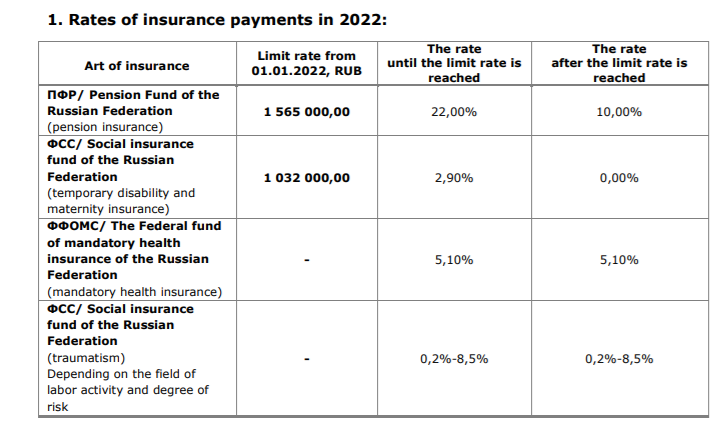
The limits and regulations for calculating insurance payments given above will be valid in 2022 for all companies, except for those with the status of SMEs.
2. Social contributions for SMEs in 2022:
We remind you that in accordance with the Federal Law of 01.04.2020 № 102-FZ dated April 1, 2020, the total amount of insurance payments for SME to state extrabudgetary funds in respect of payments to individuals, in excess of the minimum monthly wage, is reduced to 15%.
This reduced rate for SME applies irrespective of the maximum amount of payments to an individual (see above). At the same time, a part of payments less than or equal to the minimum monthly wage (determined at the end of each calendar month) is taxable at the general insurance contribution rate of 30%.
The value of the minimum monthly wage is set simultaneously on the entire territory of the Russian Federation by the federal law and is subject to annual indexation.
The minimum wage is established at the rate of 13 890 rubles for 2022 (Federal law N 406-FZ dated 06.12.2021).
Please note! Reduced tariff of insurance payments for SME from 01.01.2021 is determined for unlimited term (Item 17, clause 1, Art. 427 of the Tax Code, as amended from 01.01.2021).
We will be happy to answer your questions!
Contacts:
Natalia Safiulina
Ekaterina Babenko
Other news
28.10.2026
Key personal data regulation developments: summer 2026 review
This review focuses on key developments in the field of personal data regulation that occurred in the summer of 2026 and to which we would like to draw your attention.
06.10.2026
Legislative and Enforcement Practice Digest: September 2026
September 2026 developments in payments, banking, supplies, taxation, corporate law and employment. Adopted and expected changes and upcoming business deadlines.
06.10.2026
Federal Notarial Chamber Clarifies a Number of Issues Regarding the Adoption of Decisions by Participants of an LLC
The Federal Notarial Chamber (FNC), in its letter dated 06.07.2026 No. 6442/06-06, clarified issues that limited liability companies (LLCs) and the banks servicing them regularly encounter in practice. These clarifications directly affect a…
Inclusion of license fees in the customs value
Earlier, we provided you with an overview of the current situation with the liquidation of LLCs in Russia.
In addition to the previous review, we would like to further draw your attention to this year’s innovation: a simplified liquidation procedure.
A simplified liquidation procedure is available for SMEs (for the latest information on the status of SMEs, see here and here) and allows you to reduce the time and cost of the liquidation procedure, as well as reduce possible risks of improper liquidation (for example, restrictions on participation and management in new companies within three years).
However, not all SMEs are eligible for simplified liquidation by default. To do this, the company must comply with a list of certain additional criteria.
What conditions must be met to be eligible for simplified liquidation?
- All founders (members) of the company made a resolution to terminate activities unanimously.
- The company is included in the unified register of small and medium enterprises (SMEs).
- The company is not a VAT payer (it is on a simplified tax system) or is exempt fr om VAT.
- The company does not have debts to creditors, including debts to employees and the state budget.
- There are no marks in the Unified State Register of Legal Entities about the inaccuracy of data and about the initiation of bankruptcy proceedings.
- The company has no real estate and vehicles in the property.
- The organization is not in the process of liquidation, reorganization or in the process of forced exclusion from the Unified State Register of Legal Entities by decision of the Federal Tax Service.
How to implement simplified liquidation?
To start a simplified liquidation, you must submit an application to the tax service on form P19001. At the moment, the paper and electronic formats of this form have not yet been approved, at the current stage, you can familiarize yourself with the draft form.
In the application, the founders (members) of the company confirm that:
- All financial obligations to counterparties have been fulfilled.
- All payments due to dismissed employees have been made.
- No later than one business day before exclusion from the Unified State Register of Legal Entities, all taxes have been paid and final tax reporting has been provided.
The application can be submitted electronically (using an enhanced qualified electronic signature of each participant), directly to the tax service on paper (notarization of signatures will be required) or through a notary public.
What is the time lim it for simplified liquidation?
The tax service will check the application and within 5 business days will make a decision on the upcoming exclusion of the company from the Unified State Register of Legal Entities or refusal.
In case of a positive decision by the tax service, information about the upcoming exclusion of the company from the register will be published in the Unified State Register of Legal Entities and in the State Registration Bulletin.
Within 3 months from the date of publication in the bulletin, the creditors of the company will be able to send their objections, if any.
If there are no objections from creditors within 3 months, the liquidated company will be excluded from the register.
It is important to know:
The initial conditions for simplified liquidation must be met at the time of exclusion. If during this period the company accumulates debts or assets, or fails to submit reports, simplified liquidation will not take place.
Contacts:
Maria Matrossowa
Project leader swilar OOO Project Manager of SWILAR LLC
maria.matrossowa@swilar.ru + 7 499 978 37 87 (ext. 308)Tatiana Ushakova
Other news
28.10.2026
Key personal data regulation developments: summer 2026 review
This review focuses on key developments in the field of personal data regulation that occurred in the summer of 2026 and to which we would like to draw your attention.
06.10.2026
Legislative and Enforcement Practice Digest: September 2026
September 2026 developments in payments, banking, supplies, taxation, corporate law and employment. Adopted and expected changes and upcoming business deadlines.
06.10.2026
Federal Notarial Chamber Clarifies a Number of Issues Regarding the Adoption of Decisions by Participants of an LLC
The Federal Notarial Chamber (FNC), in its letter dated 06.07.2026 No. 6442/06-06, clarified issues that limited liability companies (LLCs) and the banks servicing them regularly encounter in practice. These clarifications directly affect a…